Assessing the Impact of Multilane Free Flow on Vehicle Operating Costs and Logistics Efficiency in Indonesia Using SWOT Analysis Approach

Downloads
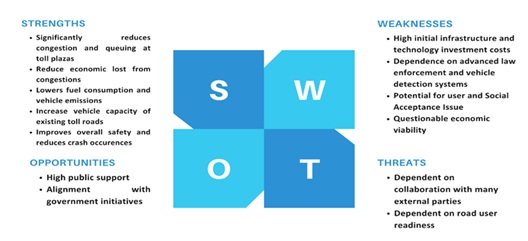
Indonesia’s logistics sector faces high costs and inefficiencies due to toll road congestion and delays. Multilane Free Flow (MLFF) offers a solution by enabling seamless toll transactions that can reduce delays and costs. Using a SWOT framework, with RBV and Institutional Theory, this study assesses MLFF’s impact. It highlights MLFF’s strengths in efficiency, lower VOC, safety, and environmental benefits. Challenges include technological accuracy, financial viability, user acceptance, and fragmented regulations. Public support offers opportunities for adoption, but implementation needs regulatory reform, infrastructure upgrades, and stakeholder collaboration. MLFF could reduce logistics costs and enhance competitiveness, but success depends on overcoming hurdles through coordinated efforts.
Downloads
[1] V. Eriksson, A. Dubois, and K. Hulthén, “Transport in supply networks,” IJLM, vol. 33, no. 5, pp. 85–106, Dec. 2022, doi: 10.1108/IJLM-06-2021-0350.
[2] S. Sarjana, N. Khayati, L. Warini, and P. Wiyati, “The Importance of Transportation Management in Optimizing Supply Chain Management at Industrial Estate,” j.trans.mtm, vol. 18, no. 1, Nov. 2020, doi: 10.25104/mtm.v18i1.1643.
[3] M. H. Abdelati and H. A. Abdelwali, “Evaluating the Impact of Transportation Costs, Supply Chain Reliability, and Operational Efficiency on Global Import Decisions,” International Journal of Advanced Engineering and Business Sciences, vol. 5, no. 3, pp. 0–0, Dec. 2024, doi: 10.21608/ijaebs.2024.317220.1099.
[4] M. C.-P. Poo, Y. Lau, B. Qi, and C. F. Pun, “Sustainable Ground Transportation and the E-Commerce Revolution: Innovations and Challenges at the Intersection,” Encyclopedia, vol. 4, no. 1, pp. 201–214, Jan. 2024, doi: 10.3390/encyclopedia4010017.
[5] V. Mamonov and V. Poluektov, “The Impact of Transport Costs on Sales in Supply Chains,” in International Scientific Conference Energy Management of Municipal Facilities and Sustainable Energy Technologies EMMFT 2019, vol. 1258, V. Murgul and V. Pukhkal, Eds., in Advances in Intelligent Systems and Computing, vol. 1258. , Cham: Springer International Publishing, 2021, pp. 820–829. doi: 10.1007/978-3-030-57450-5_69.
[6] A. Z. Abideen, S. Sorooshian, V. P. K. Sundram, and A. Mohammed, “Collaborative insights on horizontal logistics to integrate supply chain planning and transportation logistics planning – A systematic review and thematic mapping,” Journal of Open Innovation: Technology, Market, and Complexity, vol. 9, no. 2, p. 100066, Jun. 2023, doi: 10.1016/j.joitmc.2023.100066.
[7] S. Narayan, “E-Commerce and International Trade: The Case for Indonesia and Malaysia,” Emerging Markets Finance and Trade, vol. 61, no. 9, pp. 2616–2642, Jul. 2025, doi: 10.1080/1540496X.2025.2461244.
[8] M. Viu-Roig and E. J. Alvarez-Palau, “The Impact of E-Commerce-Related Last-Mile Logistics on Cities: A Systematic Literature Review,” Sustainability, vol. 12, no. 16, p. 6492, Aug. 2020, doi: 10.3390/su12166492.
[9] M. A. Al-Shboul, “An investigation of transportation logistics strategy on manufacturing supply chain responsiveness in developing countries: the mediating role of delivery reliability and delivery speed,” Heliyon, vol. 8, no. 11, p. e11283, Nov. 2022, doi: 10.1016/j.heliyon.2022.e11283.
[10] E. Subiyanto, “Investigating the logistics costs model: recent update in Indonesia,” JSTPM, vol. 12, no. 2, pp. 331–350, Jun. 2021, doi: 10.1108/JSTPM-03-2020-0034.
[11] S. Santoso, R. Nurhidayat, G. Mahmud, and A. M. Arijuddin, “Measuring the Total Logistics Costs at the Macro Level: A Study of Indonesia,” Logistics, vol. 5, no. 4, p. 68, Oct. 2021, doi: 10.3390/logistics5040068.
[12] “Pelindo Company Profile,” PT Pelabuhan Indonesia, Company Profile, 2022. [Online]. Available: https://s3.pelindo.co.id/corporate/upload/ppid.pelindo.co.id.00009.content.lists.0.items.content.lists.0.items.1.link.file/tsMvx7c9tI3bcKeYPmSfXsTxb4cqyV8EGiLkbixI.pdf#page=3.00
[13] M. Ahmad, “Disruptions in Supply Chain Transportation: A Literature Review,” in 4th International Conference on Administrative & Financial Sciences, Cihan University-Erbil, 2023, pp. 23–28. doi: 10.24086/ICAFS2023/paper.894.
[14] A. Febransyah and J. I. C. Goni, “Measuring the supply chain competitiveness of e-commerce industry in Indonesia,” CR, vol. 32, no. 2, pp. 250–275, Feb. 2022, doi: 10.1108/CR-05-2020-0059.
[15] B. Gena, D. Arief, K. Tridoyo, and Z. Nimmi, “Competitive advantage improvement strategy of container shipping industry: case of Indonesia,” IJSTL, vol. 12, no. 4, p. 307, 2020, doi: 10.1504/IJSTL.2020.108403.
[16] L. N. N. Hidayati, G. De Jong, and A. Whiteing, “Logistics Model for Indonesia’s National Freight Model System: From a Deterministic to a Stochastic Framework,” Transportation Research Record: Journal of the Transportation Research Board, p. 03611981241270181, Aug. 2024, doi: 10.1177/03611981241270181.
[17] C. Amin, A. Wahab Hasyim, M. Sun’an, Yetty, R. Millanida Hilman, and H. Fahmiasari, “Impact of increasing local economic capacity on reducing maritime logistics costs in island Province of eastern Indonesia: A dynamic system approach,” Transportation Research Interdisciplinary Perspectives, vol. 27, p. 101195, Sep. 2024, doi: 10.1016/j.trip.2024.101195.
[18] T. Iskandar and R. Arifin, “Navigating Indonesia’s Logistics And Supply Chain Challenges: A Data-Driven Analysis of Logistics Performance Index,” JBPPK, vol. 16, no. 1, pp. 110–123, Dec. 2023, doi: 10.48108/jurnalbppk.v16i1.820.
[19] D. Parmaksız, M. A. Ülkü, and H. Weigand, “Investigating Rural Logistics and Transportation through the Lens of Quadruple Bottom Line Sustainability,” Logistics, vol. 8, no. 3, p. 81, Aug. 2024, doi: 10.3390/logistics8030081.
[20] J. Peprah Adu, N. Dorasamy, and S. A. Keelson, “Road transport infrastructure and supply chain asset management: evidence from manufacturing firms in the Sub-Saharan African market,” Cogent Social Sciences, vol. 10, no. 1, p. 2327586, Dec. 2024, doi: 10.1080/23311886.2024.2327586.
[21] S. Cordero and L. Pinos-Luzuriaga, “Subsidies in the WTO Framework: Types, Effects and Discussion of International Multilateral Transparency,” Revista DICERE, vol. 1, no. 2, pp. 172–213, Nov. 2024, doi: 10.33324/dicere.v1i2.839.
[22] R. Kurniawan, S. T. Sudarmo, and E. Abdurachman, “Economic Impact Analysis of Sea Toll Program Implementation in Eastern Indonesia: A Review in Papua, Maluku, and East Nusa Tenggara Regions,” Journal of Law, Politics, and Humanities, vol. 5, no. 2, pp. 1008–1017, Dec. 2024, doi: https://doi.org/10.38035/jlph.v5i2.
[23] Hartati, S. Satoto, R. Dewi, and A. Diar, “Illegal levies in education funding in Indonesia: an analysis of experiences from Jambi Province,” Cogent Social Sciences, vol. 11, no. 1, p. 2450293, Dec. 2025, doi: 10.1080/23311886.2025.2450293.
[24] M. I. Helmi, P. Pujiyono, K. Zada, M. S. Rambe, and M. M. Sahid, “Effectiveness of Criminal Offense Law Regarding Illegal Levies: Reforming Social Organizations within the Indonesian Legal Framework,” volksgeist, pp. 411–430, Dec. 2024, doi: 10.24090/volksgeist.v7i2.10882.
[25] F. T. Kurniawan, “Sustainable National Logistics Performance In Indonesia,” jisem, vol. 10, no. 27s, pp. 921–933, Mar. 2025, doi: 10.52783/jisem.v10i27s.4665.
[26] A. Adri, “Economic Losses Caused by Jakarta Traffic Congestion Reach Rp 71.4 Trillion Per Year,” Kompas. [Online]. Available: https://www.kompas.id/artikel/en-layanan-transportasi-publik-untuk-kesejahteraan-warga
[27] D. Kurniawan, D. E. Muthiariny, and L. Afifa, “BPS Logs Significant Hike in Indonesia’s Vehicle Population,” Tempo. [Online]. Available: https://en.tempo.co/read/1727362/bps-logs-significant-hike-in-indonesias-vehicle-population
[28] S. N. Salsabila, F. Nur Azizah, F. Fitriyani, S. Novriani, and N. Budisiswanto, “Analysis Of Multi Lane Free Flow Implementation At Toll Gates In Indonesia (Case Study Of Cililitan Toll Gate 2),” Jurnal sostech, vol. 4, no. 8, pp. 651–668, Aug. 2024, doi: 10.59188/jurnalsostech.v4i8.1340.
[29] G. Aksoy, “Service time thresholds at barrier-operated freeway exit toll booths,” Heliyon, vol. 10, no. 16, p. e35923, Aug. 2024, doi: 10.1016/j.heliyon.2024.e35923.
[30] F. A. Hidayat and T. Kurniawan, “Multi Lane Free Flow Policy Analysis Based On Public Service And Public Administration Legal Studies,” De Lega Lata Jurnal Ilmu Hukum, vol. 9, no. 1, pp. 116–122, 2024.
[31] M. Milenković, N. Stepanović, D. Glavić, V. Tubić, I. Ivković, and A. Trifunović, “Methodology for determining ecological benefits of advanced tolling systems,” Journal of Environmental Management, vol. 258, p. 110007, Mar. 2020, doi: 10.1016/j.jenvman.2019.110007.
[32] F. Margias, H. Lee, R. Setiawan, and E. Halim, “Perception of Users Adoption on Using Multi Lane Free Flow Systems in Reduce Vehicle Queues at Toll Gates,” in 2025 International Conference in Advances in Power, Signal, and Information Technology (APSIT), Bhubaneswar, India: IEEE, May 2025, pp. 1–6. doi: 10.1109/APSIT63993.2025.11086240.
[33] L. A. Winanti, H. Fitriani, and M. Agustien, “Implementation Plan for Multi-Lane Free Flow (MLFF) Technology on the Trans Sumatra Toll Road: A Feasibility Study,” cea, vol. 13, no. 4, pp. 3178–3195, Jul. 2025, doi: 10.13189/cea.2025.130424.
[34] Y. A. Saputra and Y. Latief, “Analytical hierarchy process on the implementation of multi lane free flow toll road transaction system in Indonesia,” 2576-8484, vol. 9, no. 3, pp. 217–227, Mar. 2025, doi: 10.55214/25768484.v9i3.5181.
[35] R. H. Karsaman, Y. Mahendra, H. Rahman, S. Sulaksono, and Transportation Engineering Research Group, Institut Teknologi Bandung, Jalan Ganesha 10, Bandung 40132, Indonesia, “Measuring the Capacity and Transaction Time of Cash and Electronic Toll Collection Systems,” j.eng.technol.sci., vol. 46, no. 2, pp. 180–194, Jul. 2014, doi: 10.5614/j.eng.technol.sci.2014.46.2.5.
[36] F. Sudirjo, M. R. Tawil, S. Imanirubiarko, L. Judijanto, and T. R. Fauzan, “The Influence of Insecurity, Perceived of Technology Innovativeness, Perceived Ease of Use and Perceived Usefulness on Consumers Intention to Use Electronic Toll Payment Cards,” jidt, pp. 92–97, Nov. 2023, doi: 10.60083/jidt.v5i4.421.
[37] A. Matar and A. M. Alkhawaldeh, “Adoption of electronic cards using Wi-Fi platform services by clients of banking sector during COVID-19 pandemic,” International Journal of Engineering Business Management, vol. 14, p. 18479790221112797, Nov. 2022, doi: 10.1177/18479790221112797.
[38] R. H. A. Wicaksana and S. W. Mudjanarko, “Analysis Of Toll Gate Traffic Delay Time Using E-Toll System On Waru-Juanda Toll Road,” prd, vol. 2, no. 1, Aug. 2019, doi: 10.29138/prd.v2i1.128.
[39] R. S. Nurdiana and Kusuma Refa Haratama, “Peluang Penggunaan Sistem Single Lane Free Flow (SLFF) Untuk Mereduksi Tundaan Pada Gerbang Tol Exit Kejapanan Utama,” Jurnal Media Publikasi Terapan Transportasi, vol. 2, no. 2, pp. 190–100, 2024.
[40] E. P. Raharjo, I. K. S. P. Adidana, K. Haryoto, and J. B. Rore, “Analysis of Toll Payment Based on Single Lane Free Flow at the Ngurah Rai Toll Gate in Realizing Transport Sustainability,” JTTL, vol. 4, no. 2, pp. 213–218, Dec. 2023, doi: 10.52920/jttl.v4i2.209.
[41] T. S. Sumardi, H. Oneyama, and M. Yanagihara, “Critical examination of multilane free-flow tolling system implementation in Indonesia,” E3S Web of Conf., vol. 479, p. 07024, 2024, doi: 10.1051/e3sconf/202447907024.
[42] M. Shahrier, A. Hasnat, J. Al‐Mahmud, A. S. Huq, S. Ahmed, and Md. K. Haque, “Towards intelligent transportation system: A comprehensive review of electronic toll collection systems,” IET Intelligent Trans Sys, vol. 18, no. 6, pp. 965–983, Jun. 2024, doi: 10.1049/itr2.12500.
[43] R. Agrawal, A. Samadhiya, A. Banaitis, and A. Kumar, “Entrepreneurial barriers in achieving sustainable business and cultivation of innovation: a resource-based view theory perspective,” MD, Feb. 2024, doi: 10.1108/MD-11-2023-2032.
[44] C. R. Ohakwe and J. Wu, “The impact of organizational sustainability on logistics performance: exploring the role of infrastructure in sustainable logistics,” The International Journal of Logistics Management, pp. 1–24, Aug. 2025, doi: 10.1108/IJLM-10-2024-0640.
[45] E. Kyeremeh, A. Yamoah, and B. Antoa Mensah, “Road Transport Efficiency and Organizational Performance: Does Traffic Infrastructure Management Matter?,” Transportation Research Record: Journal of the Transportation Research Board, vol. 2678, no. 11, pp. 2006–2017, Nov. 2024, doi: 10.1177/03611981241246786.
[46] E. P. Indriyani et al., “Sustaining Infrastructure Firm Performance Through Strategic Orientation: Competitive Advantage in Dynamic Environments,” Sustainability, vol. 17, no. 3, p. 1194, Feb. 2025, doi: 10.3390/su17031194.
[47] S. Sankaran, C. P. Killen, and A. Pitsis, “How do project-oriented organizations enhance innovation? An institutional theory perspective,” Front. Eng. Manag., vol. 10, no. 3, pp. 427–438, Sep. 2023, doi: 10.1007/s42524-023-0258-0.
[48] C. Omobhude and S. Chen, “Institutional process for infrastructural development in Nigeria,” Progress in Development Studies, vol. 20, no. 3, pp. 223–242, Jul. 2020, doi: 10.1177/1464993420937852.
[49] Y. Chen, X. Gu, Y. Gao, and T. Lan, “Sustainability with high-speed rails: The effects of transportation infrastructure development on firms’ CSR performance,” Journal of Contemporary Accounting & Economics, vol. 17, no. 2, p. 100261, Aug. 2021, doi: 10.1016/j.jcae.2021.100261.
[50] S. D. S. Neiva and R. G. Lima, “Institutional Theory and City Council as a Driver for Urban Sustainability,” in Partnerships for the Goals, W. Leal Filho, A. Marisa Azul, L. Brandli, A. Lange Salvia, and T. Wall, Eds., in Encyclopedia of the UN Sustainable Development Goals. , Cham: Springer International Publishing, 2021, pp. 588–599. doi: 10.1007/978-3-319-95963-4_116.
[51] R. Dodds and W. Smith, “Institutional theory - Assessing longitudinal change towards sustainability in Tofino, Canada,” Journal of Destination Marketing & Management, vol. 37, p. 101001, Sep. 2025, doi: 10.1016/j.jdmm.2025.101001.
[52] M. Balzano, G. Marzi, and T. Turzo, “SMEs and institutional theory: major inroads and opportunities ahead,” MD, vol. 63, no. 13, pp. 1–27, Dec. 2024, doi: 10.1108/MD-05-2023-0734.
[53] P. Tunji-Olayeni, K. Kajimo-Shakantu, T. O. Ayodele, and O. Babalola, “Promoting construction for sustainability transformation: the perspective of institutional theory,” IJBPA, Apr. 2023, doi: 10.1108/IJBPA-07-2022-0104.
[54] J. Fan, S. Mehmood, I. Hussain, S. Nazir, and A. Basit, “Transport infrastructure environmental performance: the role of stakeholders, technological integration, government policies and lean supply chain management,” Front. Environ. Sci., vol. 11, p. 1322466, Dec. 2023, doi: 10.3389/fenvs.2023.1322466.
[55] A. Wicaksono, “Strategi Pemasaran dengan menggunakan Analisis SWOT Tanpa Skala Industri Pada PT X Di Jakarta,” JMIL, vol. 1, no. 2, pp. 192–201, Dec. 2018, doi: 10.30988/jmil.v1i2.19.
[56] A. Munawar, I. Muthohar, and A. Ardiyanto, “Pengaruh Multilane Free Flow Terhadap Kinerja Jalan Tol,” Jurnal HPJI, vol. 6, no. 1, pp. 51–58, Jan. 2020.
[57] R. S. Rizal, R. H. K, and T. L. S, “Re-Evaluasi Penerapan Sistem Pengumpulan Tol Elektronis Di Indonesia,” jitter, vol. 5, no. 2, pp. 1–12, Oct. 2019, doi: 10.33197/jitter.vol5.iss2.2019.275.
[58] L. A. Winanti, H. Fitriani, and M. Agustien, “Evaluation of Transaction Time Effectiveness in the Implementation of the Multi-Lane Free Flow System (MLFF) on the Trans Sumatra Toll Road,” JTS, vol. 25, no. 2, pp. 1882–1894, Apr. 2025, doi: 10.26418/jts.v25i2.92399.
[59] N. F. Rakhafuri and B. H. Susilo, “Pengaruh Nilai Waktu Terhadap Penerapan Multi Lane Free Flow Pada Gerbang Tol Ciputat 2,” Jurnal Rekayasa Lingkungan Terbangun Berkelanjutan, vol. 1, no. 2, pp. 172–179, Jul. 2023.
[60] P. J. Recky, “Total Solution For Smart Traffic and Toll Roads Management in Indonesia,” devotion, vol. 3, no. 2, pp. 149–157, Dec. 2021, doi: 10.36418/dev.v3i2.119.
[61] M. Milenković, D. Glavić, and M. N. Mladenović, “Decision-Support Framework for Selecting the Optimal Road Toll Collection System,” Journal of Advanced Transportation, vol. 2018, pp. 1–16, May 2018, doi: 10.1155/2018/4949565.
[62] P.-H. Tseng, D.-Y. Lin, and S. Chien, “Investigating the impact of highway electronic toll collection to the external cost: A case study in Taiwan,” Technological Forecasting and Social Change, vol. 86, pp. 265–272, Jul. 2014, doi: 10.1016/j.techfore.2013.10.019.
[63] M. Abuzwidah and M. Abdel-Aty, “Safety assessment of the conversion of toll plazas to all-electronic toll collection system,” Accident Analysis & Prevention, vol. 80, pp. 153–161, Jul. 2015, doi: 10.1016/j.aap.2015.03.039.
[64] H. Yang, K. Ozbay, and B. Bartin, “Effects of Open Road Tolling on Safety Performance of Freeway Mainline Toll Plazas,” Transportation Research Record: Journal of the Transportation Research Board, vol. 2324, no. 1, pp. 101–109, Jan. 2012, doi: 10.3141/2324-12.
[65] K. Radoš, M. Brkić, and D. Begušić, “Recent Advances on Jamming and Spoofing Detection in GNSS,” Sensors, vol. 24, no. 13, p. 4210, Jun. 2024, doi: 10.3390/s24134210.
[66] N. Rahmadhiratri, F. Fuad, and S. Suartini, “Studi Perbandingan Hukum Sistem Transaksi Tol Nontunai Nirsentuh di Indonesia,” jbh, vol. 7, no. 2, pp. 170–185, Oct. 2023, doi: 10.36596/jbh.v7i2.1037.
[67] W. Winardi and H. Kustanto, “Multiplier Efek Peningkatan Investasi Sektor Industri Pengolahan di Kawasan Industri Terhadap Kinerja Sektor Pengangkutan/Logistik,” JMIL, vol. 2, no. 2, pp. 127–134, Dec. 2018, doi: 10.30988/jmil.v2i2.33.
[68] A. Y. Harnanda, S. Priyanto, and M. Z. Irawan, “Determining Factors Of Interest In The Use Of Technology Readness Based Multi Lane Free Flow (MLFF),” IJEBAR, vol. 6, no. 4, Dec. 2022, doi: 10.29040/ijebar.v6i4.7565.
[69] V. Sunartio and L. S. Putranto, “Pendapat Pengguna Jalan Tol Jabodetabek Tentang Multi Lane Free Flow,” j. mitra teknik sipil, pp. 913–924, Nov. 2023, doi: 10.24912/jmts.v6i3.24848.
[70] C. J. Malika, “Analysis factors affecting the acceptance of multi-lane free flow in Indonesia,” Int. J. Sci. Res. Arch., vol. 12, no. 1, pp. 2199–2204, Jun. 2024, doi: 10.30574/ijsra.2024.12.1.1021.
Copyright (c) 2026 Hally Hanafiah, Ratna Palupi, Aisyah Syifa Ghaniyyah, Gravila Rafa Nugraha, Muhammad Emyr Ilham

This work is licensed under a Creative Commons Attribution 4.0 International License.
JMIL Jurnal Manajemen Industri dan Logistik (Journal of Industrial and Logistics Management) is an Open Access Journal. The authors who publish the manuscript in JMIL Jurnal Manajemen Industri dan Logistik agree to the following terms:

JMIL Jurnal Manajemen Industri dan Logistik is licensed under a Creative Commons Attribution 4.0 International License. This permits anyone to copy, redistribute, remix, transmit and adapt the work provided the original work and source is appropriately cited.
This means:
(1) Under the CC-BY license, authors retain ownership of the copyright for their article, but authors grant others permission to use the content of publications in JMIL Jurnal Manajemen Industri dan Logistik in whole or in part provided that the original work is properly cited. Users (redistributors) of JMIL Jurnal Manajemen Industri dan Logistik are required to cite the original source, including the author's names, JMIL Jurnal Manajemen Industri dan Logistik as the initial source of publication, year of publication, volume number, issue, and Digital Object Identifier (DOI); (2) Authors grant JMIL Jurnal Manajemen Industri dan Logistik the right of first publication. Although authors remain the copyright owner.