Measuring the Effectiveness of Furniture Sample Export via Air Cargo in the Furniture Industry Using Simple Weighting Method

Downloads
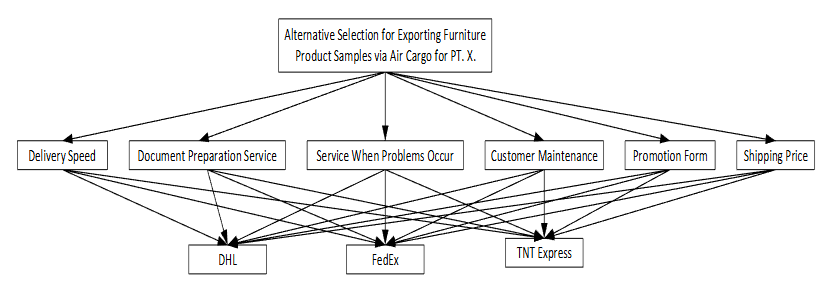
This research aims to improve logistics in Indonesia's furniture export sector, focusing on companies that face challenges in choosing the best air cargo service for product samples. While air cargo is preferred for its speed and reliability, selecting the optimal provider remains complex due to various service factors. The study applies the Simple Additive Weighting (SAW) method to evaluate air cargo services based on six criteria: delivery speed, document preparation, problem handling, customer maintenance, promotional activities, and shipping cost. The results indicate DHL as the best provider with a score of 0.93913, followed by FedEx and TNT Express. DHL excels in delivery speed and document preparation, crucial for international trade. This study highlights the SAW method's effectiveness in offering a transparent, data-driven approach to logistics decision-making, potentially benefiting other companies facing similar logistics challenges, improving shipment efficiency, reducing costs, and enhancing global competitiveness.
Downloads
[1] F. Febrianti and I. M. E. K. Yudha, “Analisis Faktor Yang Memengaruhi Ekspor Furnitur Kayu Indonesia Ke Amerika Serikat,” Innovative: Journal Of Social Science Research, vol. 4, no. 5, pp. 1496–1509, 2024, doi: 10.31004/innovative.v4i5.14880.
[2] T. Anindita and A. A. Syaputra, “Analisis Pengaruh Kurs USD, Harga Batubara Acuan, Dan Volume Produksi Terhadap Volume Ekspor Pada PT. Bukit Asam (Persero) Tbk.,” Jurnal Manajemen Industri dan Logistik, vol. 1, no. 2, pp. 111–120, Dec. 2018, doi: 10.30988/jmil.v1i2.11.
[3] M. W. Mutiara, A. P. Irawan, and E. S. Marizar, “Design Management And Preservation Of Jepara Carved Furniture,” International Journal of Application on Economics and Business, vol. 2, no. 1, pp. 2913–2922, Feb. 2024, doi: 10.24912/ijaeb.v2i1.2913-2922.
[4] L. Sugiharti, M. A. Esquivias, and B. Setyorani, “The impact of exchange rate volatility on Indonesia’s top exports to the five main export markets,” Heliyon, vol. 6, no. 1, 2020, doi: 10.1016/j.heliyon.2019.e03141.
[5] A. Straubinger, R. Rothfeld, M. Shamiyeh, K.-D. Büchter, J. Kaiser, and K. O. Plötner, “An overview of current research and developments in urban air mobility – Setting the scene for UAM introduction,” J Air Transp Manag, vol. 87, p. 101852, Aug. 2020, doi: 10.1016/j.jairtraman.2020.101852.
[6] D. A. Rudiansyah and D. Saputra, “Pengaruh Kedisiplinan Terhadap Produktivitas Karyawan Pada PT Semeru Karya Buana,” Integrasi : Jurnal Ilmiah Teknik Industri, vol. 7, no. 1, p. 42, Sep. 2022, doi: 10.32502/js.v7i1.4416.
[7] A. Asim and S. H. M. F.-A. Siddiqui, “Impact Of Logistics Service Quality On Brand Image, Customer Satisfaction and Customer Loyalty,” International Journal of Social Sciences Bulletin, vol. 3, no. 4, pp. 178–198, 2025, doi: 10.5281/zenodo.15227425.
[8] M. B. Kemokai, G. O. Marius, and M. D. Kiarie, Supply Chain Management Outline. Cari Journals USA LLC, 2023.
[9] C. Y. Kastella, F. B. Harlan, and F. D. Yudastoro, “Analysis of Trucking Company Vendor Selection in Freight Forwarding Companies using VPI, AHP, and TOPSIS Methods,” 2025, pp. 158–172. doi: 10.2991/978-94-6463-640-6_13.
[10] J. Wang, S. Setiawansyah, and Y. Rahmanto, “Decision Support System for Choosing the Best Shipping Service for E-Commerce Using the SAW and CRITIC Methods,” Jurnal Ilmiah Informatika dan Ilmu Komputer (JIMA-ILKOM), vol. 3, no. 2, pp. 101–109, Sep. 2024, doi: 10.58602/jima-ilkom.v3i2.32.
[11] S. Aggasi and M. Ulfah, “Unlocking Efficiency: A Holistic Examination of Freight Forwarder Evaluation through Analytical Hierarchy Process (AHP) at PT XYZ,” Journal of Applied Business Administration, vol. 8, no. 1, pp. 40–51, Mar. 2024, doi: 10.30871/jaba.v8i1.6497.
[12] M. Dresner and L. Zou, “Air cargo and logistics,” in Air Transport Management, Routledge, 2020, pp. 287–307.
[13] P. Adi Wicaksono, W. Budiawan, C. Alvina Prima Hapsari, and A. Dwi Lestari, “Strategic Design to Increase Indonesian Furniture Industry Export Competitiveness,” E3S Web of Conferences, vol. 448, p. 02066, Nov. 2023, doi: 10.1051/e3sconf/202344802066.
[14] Yevita Nursyanti, “Penentuan Penyedia Jasa Trucking di PT Yicheng Logistics Dengan Menggunakan Metode SAW (Simple Additive Weighting),” Jurnal Teknologi dan Manajemen Industri Terapan, vol. 1, no. 3, pp. 210–222, Sep. 2022, doi: 10.55826/tmit.v1iIII.49.
[15] J. Wang, S. Setiawansyah, and Y. Rahmanto, “Decision Support System for Choosing the Best Shipping Service for E-Commerce Using the SAW and CRITIC Methods,” Jurnal Ilmiah Informatika dan Ilmu Komputer (JIMA-ILKOM), vol. 3, no. 2, pp. 101–109, Sep. 2024, doi: 10.58602/jima-ilkom.v3i2.32.
[16] A. Ayaz and M. Yanartaş, “An analysis on the unified theory of acceptance and use of technology theory (UTAUT): Acceptance of electronic document management system (EDMS),” Computers in Human Behavior Reports, vol. 2, p. 100032, Aug. 2020, doi: 10.1016/j.chbr.2020.100032.
[17] O. Rizan, C. Kirana, Hamidah, Hengki, H. A. Pradana, and A. Pangestu, “Determination of the Best Employees to Improve Service Quality using the SAW Algorithm,” in 2021 3rd International Conference on Cybernetics and Intelligent System (ICORIS), IEEE, Oct. 2021, pp. 1–5. doi: 10.1109/ICORIS52787.2021.9649524.
[18] B. Hochstein, C. M. Voorhees, A. B. Pratt, D. Rangarajan, D. M. Nagel, and V. Mehrotra, “Customer success management, customer health, and retention in B2B industries,” International Journal of Research in Marketing, vol. 40, no. 4, pp. 912–932, Dec. 2023, doi: 10.1016/j.ijresmar.2023.09.002.
[19] M. Bertini and A. Aydinli, “Consumer Reactance to Promotional Favors,” Journal of Retailing, vol. 96, no. 4, pp. 578–589, Dec. 2020, doi: 10.1016/j.jretai.2020.03.002.
[20] V. Gružauskas and D. Ragavan, “Robotic Process Automation For Document Processing: A Case Study Of A Logistics Service Provider,” J Manage, vol. Vol. 36, no. No. 2, pp. 119–126, Dec. 2020, doi: 10.38104/vadyba.2020.2.16.
[21] A. Ghanad, “An Overview of Quantitative Research Methods,” International Journal of Multidisciplinary Research and Analysis, vol. 06, no. 08, Aug. 2023, doi: 10.47191/ijmra/v6-i8-52.
[22] Y. P. K. Kelen et al., “Decision support system for the selection of new prospective students using the simple additive weighted (SAW) method,” 2023, p. 020001. doi: 10.1063/5.0154676.
[23] R. Aurachman, “Faktor Eksternal Dalam Penentuan Strategi Dasar Program Pendidikan Bidang Rekayasa Logistik Dan Rantai Suplai,” Jurnal Manajemen Industri dan Logistik, vol. 2, no. 2, pp. 116–126, Dec. 2018, doi: 10.30988/jmil.v2i2.32.
[24] S. P. Said, D. Parikesit, and M. Z. Irawan, “Identification and analysis on stakeholder of cross-border freight transportation,” Int. J. Adv. Sci. Eng. Inf. Technol., vol. 10, no. 4, 2020, doi: 10.18517/ijaseit.10.4.9994.
[25] S. A. Mazhar, “Methods of Data Collection: A Fundamental Tool of Research,” Journal of Integrated Community Health, vol. 10, no. 01, pp. 6–10, Jun. 2021, doi: 10.24321/2319.9113.202101.
[26] Y. Wang, F. Jia, T. Schoenherr, Y. Gong, and L. Chen, “Cross-border e-commerce firms as supply chain integrators: The management of three flows,” Industrial Marketing Management, vol. 89, pp. 72–88, Aug. 2020, doi: 10.1016/j.indmarman.2019.09.004.
[27] S. Kermanshachi, B. Rouhanizadeh, and B. Dao, “Application of Delphi Method in Identifying, Ranking, and Weighting Project Complexity Indicators for Construction Projects,” Journal of Legal Affairs and Dispute Resolution in Engineering and Construction, vol. 12, no. 1, Feb. 2020, doi: 10.1061/(ASCE)LA.1943-4170.0000338.
[28] A. Jarašūnienė and M. Razgus, “Investigating Problem Issues in Customer Service Using Combined Transport,” The Baltic Journal of Road and Bridge Engineering, vol. 19, no. 4, pp. 69–95, Dec. 2024, doi: 10.7250/bjrbe.2024-19.649.
[29] L. South, D. Saffo, O. Vitek, C. Dunne, and M. A. Borkin, “Effective Use of Likert Scales in Visualization Evaluations: A Systematic Review,” Computer Graphics Forum, vol. 41, no. 3, pp. 43–55, Jun. 2022, doi: 10.1111/cgf.14521.
[30] J. Pascale, J. F. Lineback, N. Bates, and P. Beatty, “Protecting the Identity of Participants in Qualitative Research,” J Surv Stat Methodol, vol. 10, no. 3, pp. 549–567, Jun. 2022, doi: 10.1093/jssam/smab048.
[31] P. Karatsareas, “Semi-structured interviews,” Research methods in language attitudes, vol. 99, 2022.
[32] A. Bans-Akutey and B. M. Tiimub, “Triangulation in Research,” Academia Letters, Aug. 2021, doi: 10.20935/AL3392.
[33] M. A. Lubiano, M. Montenegro, S. Pérez-Fernández, and M. Á. Gil, “Analyzing the Influence of the Rating Scale for Items in a Questionnaire on Cronbach Coefficient Alpha,” 2023, pp. 377–388. doi: 10.1007/978-3-031-04137-2_32.
[34] K.-C. Yao, J.-J. Yang, H.-W. Lo, S.-W. Lin, and G.-H. Li, “Using a BBWM-PROMETHEE model for evaluating mobile commerce service quality: A case study of food delivery platform,” Research in Transportation Business & Management, vol. 49, p. 100988, Aug. 2023, doi: 10.1016/j.rtbm.2023.100988.
[35] Y. Praharsi, M. A. Jami’in, G. Suhardjito, S. Reong, and H. M. Wee, “Supply chain performance for a traditional shipbuilding industry in Indonesia,” Benchmarking: An International Journal, vol. 29, no. 2, pp. 622–663, Feb. 2022, doi: 10.1108/BIJ-05-2020-0232.
[36] H. Chen, J. Chen, and J. Ding, “Data Evaluation and Enhancement for Quality Improvement of Machine Learning,” IEEE Trans Reliab, vol. 70, no. 2, pp. 831–847, Jun. 2021, doi: 10.1109/TR.2021.3070863.
[37] B. Talumaa, A. Brown, R. L. Batterham, and A. Z. Kalea, “Effective strategies in ending weight stigma in healthcare,” Obesity Reviews, vol. 23, no. 10, Oct. 2022, doi: 10.1111/obr.13494.
[38] H. Warnars, A. Fahrudin, and W. H. Utomo, “Student performance prediction using simple additive weighting (SAW) method,” International Journal of Artificial Intelligence, vol. 9, no. 1, 2020, doi: 10.11591/ijai.v9.i1.ppxx-xx.
[39] N. Vafaei, R. A. Ribeiro, and L. M. Camarinha-Matos, “Assessing Normalization Techniques for Simple Additive Weighting Method,” Procedia Comput Sci, vol. 199, pp. 1229–1236, 2022, doi: 10.1016/j.procs.2022.01.156.
[40] D. Kurniawati, F. N. Lenti, and R. W. Nugroho, “Implementation of AHP and SAW methods for optimization of decision recommendations,” in Journal of International Conference Proceedings (JICP) Vol, 2021. doi: 10.32535/jicp.v4i1.1152.
[41] S. G. Meshram, E. Alvandi, C. Meshram, E. Kahya, and A. M. Fadhil Al-Quraishi, “Application of SAW and TOPSIS in Prioritizing Watersheds,” Water Resources Management, vol. 34, no. 2, pp. 715–732, Jan. 2020, doi: 10.1007/s11269-019-02470-x.
[42] M. Huge-Brodin, E. Sweeney, and P. Evangelista, “Environmental alignment between logistics service providers and shippers – a supply chain perspective,” The International Journal of Logistics Management, vol. 31, no. 3, pp. 575–605, Aug. 2020, doi: 10.1108/IJLM-04-2019-0101.
[43] C. Dirzka and M. Acciaro, “Global shipping network dynamics during the COVID-19 pandemic’s initial phases,” J Transp Geogr, vol. 99, p. 103265, Feb. 2022, doi: 10.1016/j.jtrangeo.2021.103265.
[44] T. Hines, Supply chain strategies: Demand driven and customer focused. Routledge, 2024.
[45] A. Gupta, R. K. Singh, K. Mathiyazhagan, P. K. Suri, and Y. K. Dwivedi, “Exploring relationships between service quality dimensions and customers satisfaction: empirical study in context to Indian logistics service providers,” The International Journal of Logistics Management, vol. 34, no. 6, pp. 1858–1889, Dec. 2023, doi: 10.1108/IJLM-02-2022-0084.
[46] M. Garg, “Performance Drivers & Future Growth Prospects of the Logistic Service Providers (3PL) in the Indian Surface Logistics Sector,” Digital Repository of Theses-SSBM Geneva, 2025.
[47] Z. Yu, J. Zhou, P. Jiang, and S. Liu, “Rethinking service failure and recovery process: insights from a leading airline in China,” International Journal of Contemporary Hospitality Management, vol. 37, no. 8, pp. 2676–2693, Aug. 2025, doi: 10.1108/IJCHM-09-2024-1410.
[48] S. Asawawibul, K. Na-Nan, K. Pinkajay, N. Jaturat, Y. Kittichotsatsawat, and B. Hu, “The influence of cost on customer satisfaction in e-commerce logistics: Mediating roles of service quality, technology usage, transportation time, and production condition,” Journal of Open Innovation: Technology, Market, and Complexity, vol. 11, no. 1, p. 100482, Mar. 2025, doi: 10.1016/j.joitmc.2025.100482.
[49] J. R. McColl-Kennedy, L. Cheung, and L. V. Coote, “Tensions and trade-offs in multi-actor service ecosystems,” J Bus Res, vol. 121, pp. 655–666, Dec. 2020, doi: 10.1016/j.jbusres.2020.06.055.
[50] O. A. El-Said, “Impact of online reviews on hotel booking intention: The moderating role of brand image, star category, and price,” Tour Manag Perspect, vol. 33, p. 100604, Jan. 2020, doi: 10.1016/j.tmp.2019.100604.
[51] A. M. Mostafa, “An MCDM Approach for Cloud Computing Service Selection Based on Best-Only Method,” IEEE Access, vol. 9, pp. 155072–155086, 2021, doi: 10.1109/ACCESS.2021.3129716.
[52] A. Sencer and A. Karaismailoglu, “A simulation and analytic hierarchy process based decision support system for air cargo warehouse capacity design,” Simulation, vol. 98, no. 3, pp. 235–255, Mar. 2022, doi: 10.1177/00375497211029915.
[53] M. C. Ochego and A. Wycliffe, “Logistics strategy as a competitive tool for firm performance: The moderating effect of customer service effectiveness,” Journal of Sustainable Development of Transport and Logistics, vol. 5, no. 1, pp. 56–65, 2020, doi: 10.14254/jsdtl.2020.5-1.6.
[54] A. Sachan and A. Adhikari, “Demand issues in supply chain management,” in Supply Chain Management, CRC Press, 2024, pp. 34–57.
[55] M. Luca and M. H. Bazerman, The power of experiments: Decision making in a data-driven world. Mit Press, 2021.
[56] B. Feng, Y. Li, and Z.-J. M. Shen, “Air cargo operations: Literature review and comparison with practices,” Transp Res Part C Emerg Technol, vol. 56, pp. 263–280, Jul. 2015, doi: 10.1016/j.trc.2015.03.028.
[57] F. A. F. Fika Ananda Fortuna, A. C. J. Agnes Cintia Jayanti, T. P. Taryono Purba, and M. I. Mohammad Ichsan, “Identification of Key Success Factors in Performing Effective Logistic Management: A Case Study of XYZ Ltd. Manufacturing Company,” Global Business Finance Review, vol. 30, no. 1, pp. 58–69, Jan. 2025, doi: 10.17549/gbfr.2025.30.1.58.
[58] O. J. Oteri, E. C. Onukwulu, A. N. Igwe, C. P.-M. Ewim, A. I. Ibeh, and A. Sobowale, “Dynamic Pricing Models for Logistics Product Management: Balancing Cost Efficiency and Market Demands,” International Journal of Multidisciplinary Research and Growth Evaluation, vol. 4, no. 1, pp. 861–869, 2023, doi: 10.54660/.IJMRGE.2023.4.1-861-869.
[59] A. L. Ostrom, A. Parasuraman, D. E. Bowen, L. Patrício, and C. A. Voss, “Service Research Priorities in a Rapidly Changing Context,” J Serv Res, vol. 18, no. 2, pp. 127–159, May 2015, doi: 10.1177/1094670515576315.
[60] A. Paul, Md. A. Moktadir, and S. K. Paul, “An innovative decision-making framework for evaluating transportation service providers based on sustainable criteria,” Int J Prod Res, vol. 58, no. 24, pp. 7334–7352, Dec. 2020, doi: 10.1080/00207543.2019.1652779.
Copyright (c) 2025 Peni Shoffiyati, Dian Purnomo, Fesa Kristianto

This work is licensed under a Creative Commons Attribution 4.0 International License.
JMIL Jurnal Manajemen Industri dan Logistik (Journal of Industrial and Logistics Management) is an Open Access Journal. The authors who publish the manuscript in JMIL Jurnal Manajemen Industri dan Logistik agree to the following terms:

JMIL Jurnal Manajemen Industri dan Logistik is licensed under a Creative Commons Attribution 4.0 International License. This permits anyone to copy, redistribute, remix, transmit and adapt the work provided the original work and source is appropriately cited.
This means:
(1) Under the CC-BY license, authors retain ownership of the copyright for their article, but authors grant others permission to use the content of publications in JMIL Jurnal Manajemen Industri dan Logistik in whole or in part provided that the original work is properly cited. Users (redistributors) of JMIL Jurnal Manajemen Industri dan Logistik are required to cite the original source, including the author's names, JMIL Jurnal Manajemen Industri dan Logistik as the initial source of publication, year of publication, volume number, issue, and Digital Object Identifier (DOI); (2) Authors grant JMIL Jurnal Manajemen Industri dan Logistik the right of first publication. Although authors remain the copyright owner.