Challenges of Developing Environmentally Friendly Transportation Infrastructure in Urban Areas

Downloads
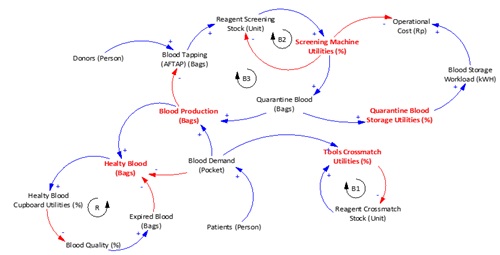
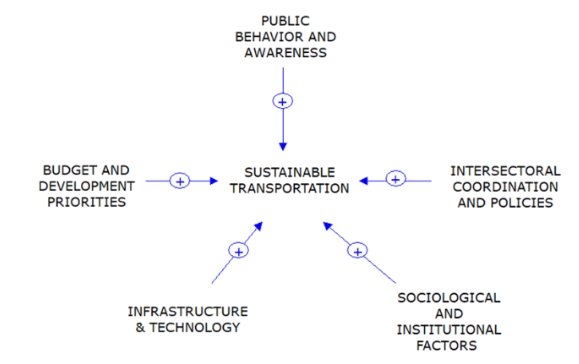
This research aims to identify and analyze the main challenges in developing environmentally friendly transportation infrastructure in urban areas, as well as to provide technical solutions based on calculations and scientific approaches in the field of transportation infrastructure engineering.The method used is a descriptive qualitative approach, with data collection through literature studies and field observations. The results of the study indicate that the development of environmentally friendly transportation in urban areas faces various challenges, ranging from budget constraints, weak coordination between sectors, to low public awareness. To strengthen the qualitative data, a system dynamics based on quantitative data is used with simulation 1 showing sustainability up to 30% of 100%, simulation 2 up to 25% of 100%, simulation 3 up to 20% of 100%, simulation 4 up to 15% of 100%, and simulation 5 up to 10% of 100%, thus showing that the factor that must be maximized is infrastructure and technology.
Downloads
[1] A. D. Dwipayana and N. L. Darmayanti, "Green Energy Development Strategy Towards Green Logistics: Case Study At PT. Pelabuhan Indonesia III (Persero) Benoa Bali," Jurnal Manajemen Industri dan Logistik, vol. 8, no. 1, pp. 81-96, 2024.
[2] A. Kumar, A. Poddar, and A. Nautiyal, "Urban transportation system problems in context of the Indian conditions," in Belt and Road Webinar Series on Geotechnics, Energy and Environment: Springer, 2021, pp. 300-314.
[3] I. Jamal, N. P. T. Widanti, I. A. P. S. Widnyani, and S. BIdul, "Kebijakan Transportasi Umum Berbasis Energi Ramah Lingkungan Di Kota Denpasar," Innovative: Journal Of Social Science Research, vol. 4, no. 3, pp. 3220-3234, 2024.
[4] M. Borgstede and M. Scholz, "Quantitative and qualitative approaches to generalization and replication–A representationalist view," Frontiers in psychology, vol. 12, p. 605191, 2021.
[5] P. Miner, B. M. Smith, A. Jani, G. McNeill, and A. Gathorne-Hardy, "Car harm: A global review of automobility's harm to people and the environment," Journal of Transport Geography, vol. 115, p. 103817, 2024.
[6] G. Patil, G. Pode, B. Diouf, and R. Pode, "Sustainable decarbonization of road transport: policies, current status, and challenges of electric vehicles," Sustainability, vol. 16, no. 18, p. 8058, 2024.
[7] R. Anastasya and S. B. Putri, "SDGs 7: efektivitas program penggunaan bus listrik guna mendorong transportasi publik ramah lingkungan," Journal of Environmental Economics and Sustainability, vol. 1, no. 3, pp. 13-13, 2024.
[8] A. Carteni, V. Marzano, I. Henke, and E. Cascetta, "A cognitive and participative decision-making model for transportation planning under different uncertainty levels," Transport Policy, vol. 116, pp. 386-398, 2022.
[9] M. I. Mulia and N. A. Lutpi, "The impact of air pollution from motor vehicles on public health: a comprehensive analysis," Environmental and Toxicology Management, vol. 4, no. 2, 2024.
[10] L. Steg, "Limiting climate change requires research on climate action," Nature Climate Change, vol. 8, no. 9, pp. 759-761, 2018.
[11] R. M. Sari, E. Nugraha, and A. Nugraha, "Application of Value Chain Strategy to Ensure the Sustainability of Online Transportation Services," 2025.
[12] M. A. Kashem, M. Shamsuddoha, and T. Nasir, "Sustainable transportation solutions for intelligent mobility: a focus on renewable energy and technological advancements for electric vehicles (EVs) and flying cars," Future Transportation, vol. 4, no. 3, pp. 874-890, 2024.
[13] S. Ling, S. Jin, H. Wang, Z. Zhang, and Y. Feng, "Transportation infrastructure upgrading and green development efficiency: empirical analysis with double machine learning method," Journal of Environmental Management, vol. 358, p. 120922, 2024.
[14] F. Alanazi, "Electric vehicles: benefits, challenges, and potential solutions for widespread adaptation," Applied sciences, vol. 13, no. 10, p. 6016, 2023.
[15] D. Burchart, M. Gazda-Grzywacz, P. Grzywacz, P. Burmistrz, and K. Zarębska, "Life cycle assessment of hydrogen production from coal gasification as an alternative transport fuel," Energies, vol. 16, no. 1, p. 383, 2022.
[16] N. Ngcobo, O. Akinradewo, and P. Mokoena, "Challenges to sustainable transport infrastructure integration in Johannesburg, South Africa," Journal of Sustainable Development of Transport and Logistics, vol. 9, no. 2, pp. 92-108, 2024.
[17] A. M. Selim and D. M. Saeed, "Infrastructure projects for green cities between implementation challenges and efficiency indicators," transport, vol. 5, p. 6, 2021.
[18] H. Sabrina, E. D. S. Tarigan, A. M. U. Nasution, and T. Parulian, "Pengaruh Gaya Hidup dan Pengetahuan terhadap Keputusan Pembelian Produk Ramah Lingkungan di Kota Medan," Juripol (Jurnal Institusi Politeknik Ganesha Medan), vol. 5, no. 1, pp. 67-77, 2022.
[19] K. M. Alhosani, Y. O. Kaied, and A. S. K. Darwish, "Ajman an environmentally friendly city with its quality of life: review of sustainability challenges and achievements by Ajman Municipality and Planning Department," Renewable Energy and Environmental Sustainability, vol. 6, p. 12, 2021.
[20] M. T. Siregar and G. Y. Samodra, "Analysis of Service Delivery Improvement of Manufactured Products with Lean Method Management," Journal of Management Science & Engineering research, vol. 3, no. 2, pp. 26-30, 2020.
[21] N. Kalyviotis, C. D. Rogers, M. R. Tight, G. J. Hewings, and H. Doloi, "The environmental value of sustainable transport infrastructure," RELAND: International Journal of Real Estate & Land Planning, vol. 1, pp. 42-57, 2018.
[22] A. A. Zuniga-Teran et al., "Challenges of mainstreaming green infrastructure in built environment professions," Journal of Environmental Planning and Management, vol. 63, no. 4, pp. 710-732, 2020.
[23] A. M. Al-Ghaili, H. Kasim, H. Aris, and N. M. Al-Hada, "Can electric vehicles be an alternative for traditional fossil-fuel cars with the help of renewable energy sources towards energy sustainability achievement?," Energy Informatics, vol. 5, no. Suppl 4, p. 60, 2022.
[24] S. Cho, K. Choi, and Y. Yi, "Proactive and Sustainable Transport Investment Strategies to Balance the Variance of Land Use and House Prices: A Korean Case," Sustainability, vol. 14, no. 21, p. 14191, 2022.
[25] Ł. Brzeziński and A. Kolinski, "Challenges of the green transformation of transport in Poland," Sustainability, vol. 16, no. 8, p. 3418, 2024.
[26] Y. Bicer and I. Dincer, "Life cycle environmental impact assessments and comparisons of alternative fuels for clean vehicles," Resources, Conservation and Recycling, vol. 132, pp. 141-157, 2018.
[27] D. M. Chhetri, K. Wangmo, K. Dechen, S. Choden, and C. Chimi, "Green Urbanism: Adopting Sustainable Transport in Phuntsholing City," Bhutan Journal of Research and Development, 2022.
Copyright (c) 2025 Muhammad Fajar Subkhan, Muhammad Taali

This work is licensed under a Creative Commons Attribution 4.0 International License.
JMIL Jurnal Manajemen Industri dan Logistik (Journal of Industrial and Logistics Management) is an Open Access Journal. The authors who publish the manuscript in JMIL Jurnal Manajemen Industri dan Logistik agree to the following terms:

JMIL Jurnal Manajemen Industri dan Logistik is licensed under a Creative Commons Attribution 4.0 International License. This permits anyone to copy, redistribute, remix, transmit and adapt the work provided the original work and source is appropriately cited.
This means:
(1) Under the CC-BY license, authors retain ownership of the copyright for their article, but authors grant others permission to use the content of publications in JMIL Jurnal Manajemen Industri dan Logistik in whole or in part provided that the original work is properly cited. Users (redistributors) of JMIL Jurnal Manajemen Industri dan Logistik are required to cite the original source, including the author's names, JMIL Jurnal Manajemen Industri dan Logistik as the initial source of publication, year of publication, volume number, issue, and Digital Object Identifier (DOI); (2) Authors grant JMIL Jurnal Manajemen Industri dan Logistik the right of first publication. Although authors remain the copyright owner.