Optimizing Online Transportation Efficiency with a Value Chain Taguchi Method Approach

Downloads
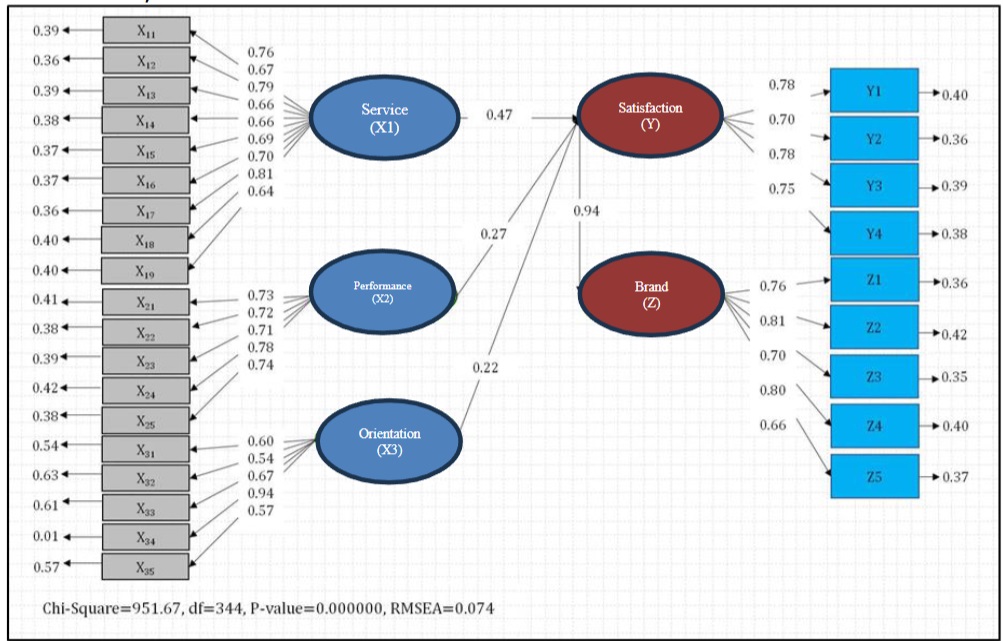
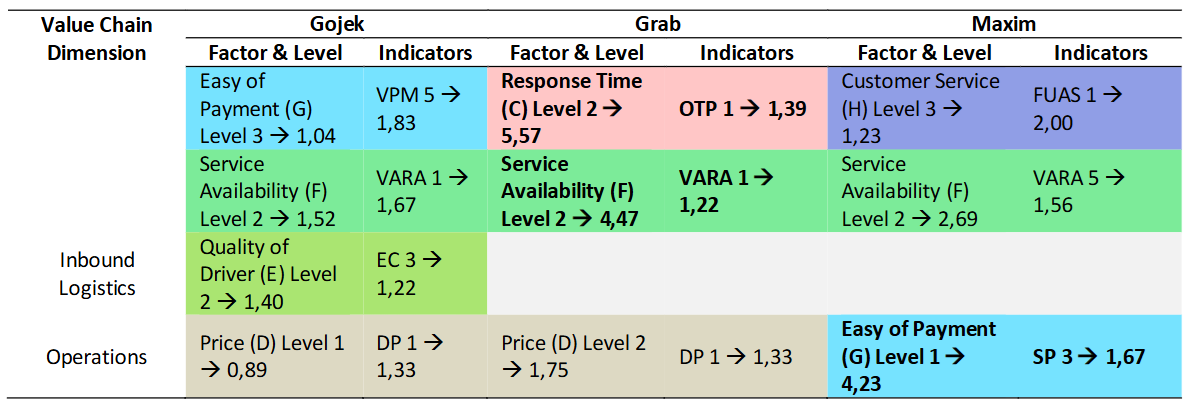
This study explores how applying the Taguchi method as a robust design tool can strengthen value chain integration in Indonesia’s ride-hailing services. A survey of 162 users was conducted, with responses examined through factor allocation, variance analysis, and a structured quality control cycle covering verification, validation, implementation, feedback, documentation, and reporting. The findings highlight several service quality drivers: timely response during peak demand, transparent pricing, convenient digital payments, and dependable customer support. The results reveal gaps between actual operations and customer expectations, underscoring the need for tighter alignment. By positioning the Taguchi method within a service-based value chain, this research introduces a novel contribution, demonstrating how quality design principles traditionally applied in manufacturing can enhance efficiency, resilience, and customer satisfaction in the competitive ride-hailing sector.
Downloads
[1] R. B. Erlangga and H. C. Wahyuni, “Application of Quality Control using Six Sigma and Taguchi Method on UMKM Kerupuk Tahu Bangil in Pandemic Period (Case Study: UD. Sanusi),” Procedia Eng. Life Sci., vol. 3, no. December, 2023, doi: 10.21070/pels.v3i0.1331.
[2] S. M. Uddin, “Operational Strategies and Management of Kfc: an Enquiry,” EPRA Int. J. Res. Dev., vol. 5, no. 4, pp. 172–179, 2020.
[3] D. F. Adhim and N. B. Mulyono, “Supply Chain Financing System Factors, Solutions, and Benefits: A Systematic Literature Review,” Oper. Supply Chain Manag., vol. 16, no. 2, pp. 242–253, 2023, doi: 10.31387/oscm0530386.
[4] M. K. C. S. Wijewickrama, N. Chileshe, R. Rameezdeen, and J. J. Ochoa, “Information-centric influence strategies for quality assurance in reverse logistics supply chains: external stakeholders’ perspective,” Benchmarking, vol. 29, no. 6, pp. 1857–1888, 2022, doi: 10.1108/BIJ-05-2021-0276.
[5] N. Y. Abidalreda and S. A. Jawad, “Using some of quality techniques in Supply chain management to improve the production processes,” Int. J. Supply Chain Manag., vol. 8, no. 4, pp. 772–787, 2019.
[6] D. R. S. Dewi and Y. B. Hermanto, “Achieving Supply Chain Agility Through Product–Service Systems Offering,” J. Ind. Eng. Manag., vol. 17, no. 2, pp. 611–629, 2024, doi: 10.3926/jiem.7521.
[7] U. A. A. Anwar, A. Rahayu, and L. A. Wibowo, “Operation Process Integration Using Supplier Selection, Supply Chain Agility and Logistic Management to Optimize Corporate Performance Based on Enterprise Resource Strategic,” in Proceedings of the 7th Global Conference on Business, Management, and Entrepreneurship (GCBME 2022), Atlantis Press International BV, 2024, pp. 1570–1584. doi: 10.2991/978-94-6463-234-7_165.
[8] D. Dzemydienė, A. Burinskienė, and K. Čižiūnienė, “An Approach of Integration of Contextual Data in E-Service System for Management of Multimodal Cargo Transportation,” Sustainability, vol. 16, no. 18, p. 7893, 2024, doi: 10.3390/su16187893.
[9] D. Asamoah, D. Nuertey, B. Agyei-Owusu, and J. Akyeh, “The effect of supply chain responsiveness on customer development,” Int. J. Logist. Manag., vol. 32, no. 4, pp. 1190–1213, 2021, doi: 10.1108/IJLM-03-2020-0133.
[10] R. Toorajipour, V. Sohrabpour, A. Nazarpour, P. Oghazi, and M. Fischl, “Artificial intelligence in supply chain management: A systematic literature review,” J. Bus. Res., vol. 122, no. September 2020, pp. 502–517, 2021, doi: 10.1016/j.jbusres.2020.09.009.
[11] I. Diez-Martinez and A. Peiro-Signes, “Transitioning towards sustainability: The ‘what’, ‘why’ and ‘how’ of the integration of sustainable practices into business models,” Tec Empres., vol. 16, no. 1, pp. 44–86, 2022, doi: 10.18845/te.v16i1.6013.
[12] Z. Zhu, “The Relationship Between Supply Chain Management and Customer Relationship Management,” Proc. 2022 7th Int. Conf. Financ. Innov. Econ. Dev. (ICFIED 2022), vol. 648, no. Icfied, pp. 3028–3033, 2022, doi: 10.2991/aebmr.k.220307.494.
[13] T. N. Duening, R. A. Hisrich, and M. A. Lechter, Technology Entrepreneurship Taking Innovation to the Marketplace. Elsevier Science, 2020.
[14] E. R. Crandall and W. R. Crandall, How Management Programs Can Improve Performance: Selecting and Implementing the Best Program for Your Organization. Information Age Publishing, Inc., 2015.
[15] M. Helmold, Virtual and Innovative Quality Management Across the Value Chain Industry Insights, Case Studies and Best Practices. Springer Nature Switzerland AG, 2023. doi: https://doi.org/10.1007/978-3-031-30098-9.
[16] X. Xu and T.-M. Choi, “Supply chain operations with online platforms under the cap-and-trade regulation: Impacts of using blockchain technology,” Transp. Res. Part E Logist. Transp. Rev., vol. 155, no. 11, 2021, doi: https://doi.org/10.1016/j.tre.2021.102491.
[17] E. Madina, “Marketing Logistics as a Leading Factor in Improving the Competitiveness of Enterprises,” Eur. J. Res. Dev. Sustain., vol. 2, no. 4, pp. 34–35, 2021.
[18] J. Basalamah, M. H. Syahnur, M. Ashoer, and A. F. Bahari, “Consumer Behavior in Online Transportation Services : A Systematic review of Business Strategies,” Ilomata Int. J. Manag., vol. 1, no. 3, pp. 134–144, 2020.
[19] B. Bentalha and A. Hmioui, “Digital Service Supply Chain Management : Current Realities and Prospective Visions Lecture Notes in Intelligent Transportation and Infrastructure,” in The Proceedings of the 4th International Conference on Smart City Applications, 2020, pp. 808–822. doi: 10.1007/978-3-030-37629-1.
[20] A. Gola, Ed., Design and Management of Manufacturing Systems. MDPI AG, 2021.
[21] A. Mitra, Fundamentals of Quality Control and Improvement. Wiley, 2021.
[22] K. Siregar, A. Ishak, F. Ariani, and R. Spencer, “Quality Assessment Using Quality Loss Function Method in PT . QRS Quality Assessment Using Quality Loss Function Method in PT . QRS,” in IOP Conference Series: Materials Science and Engineering, IOP Publishing Ltd, 2020, pp. 1–6. doi: 10.1088/1757-899X/1003/1/012104.
[23] T. Eifler, F. Campean, S. Husung, and B. Schleich, “Perspective on Robust Design - An Overview of Challenges and Research Areas Across Industry Fields,” in Proceedings of the international Conference on Engineering Design (ICED23), Cambridge University Press, 2023, pp. 2885–2894. doi: 10.1017/pds.2023.289.
[24] P. Chebotayev, D. Urazayev, I. Pospelova, A. Karassenko, D. Zykov, and A. Shelupanov, “Analysis of the level of SNR in the PLC channel based on the results of mathematical and physical modelling Analysis of the level of SNR in the PLC channel based on the results of mathematical and physical modelling,” in IOP Conf. Series: Journal of Physics: Conf. Series 1145 (2019) 012013, IOP Publishing Ltd, 2019, pp. 1–8. doi: 10.1088/1742-6596/1145/1/012013.
[25] H. Cui, L. Gong, Y. Yan, Z. Mo, X. Xiang, and X. Liu, “ScienceDirect An integrated approach for selecting design parameters in smart product-service system conceptual design,” in 30th CIRP Design Conference, Elsevier B.V., 2023, pp. 278–283. doi: 10.1016/j.procir.2023.01.003.
[26] J. A. Garza-Reyes, V. Kumar, J. L. Martinez-Covarrubias, and M. K. Lim, Managing Innovation and Operations in the 21st Century. Taylor & Francis, 2017.
[27] D. Gardiner and H. Reefke, Operations Management for Business Excellence: Building Sustainable Supply Chains. Routledge, 2020.
[28] J. A. Okechukwu and H. Hubs, “Supply Chain Drivers: Effect on Service Delivery,” Eur. J. Mark. Manag. Sci., vol. 5, no. 06, pp. 84–93, 2023.
[29] A. L. Setyabudhi, H. L. Napitupulu, R. Ginting, and M. T. Sembiring, “Streamlining logistics : Innovating cross-docking distribution systems for operational excellence,” J. Infrastructure, Policy Dev., vol. 8, no. 12, pp. 1–21, 2024.
[30] S. F. Alkhatib and R. A. Momani, “Supply Chain Resilience and Operational Performance: The Role of Digital Technologies in Jordanian Manufacturing Firms,” Adm. Sci., vol. 13, no. 2, 2023, doi: 10.3390/admsci13020040.
[31] H. M. Alzoubi, M. T. Alshurideh, B. Al Kurdi, and M. In, “Do perceived service value , Quality , price fairness and service recovery shape customer satisfaction and delight ? A practical study in the service telecommunication context,” Uncertain Supply Chain Manag., no. February, 2020, doi: 10.5267/j.uscm.2020.2.005.
[32] M. Shaiq, S. Khurram, S. Shaikh, and Z. Zaman, “Quality management as driver of vertical integration in service chain: A study of 3rd party logistics industry,” Oper. Supply Chain Manag., vol. 13, no. 3, pp. 244–255, 2020, doi: 10.31387/OSCM0420266.
[33] Y. Shen and B. Panichakarn, “Sustainability of agricultural trade supply chains status, opportunities, and future directions,” Uncertain Supply Chain Manag., vol. 11, no. 4, pp. 1769–1782, 2023, doi: 10.5267/j.uscm.2023.6.014.
[34] P. B. Sangode, “Supply Chain Risk Model for Cement Industry Based on Interpretive Structural Model Driven by FMEA,” J. Ind. Eng. Manag., vol. 16, no. 3, pp. 473–492, 2023, doi: 10.3926/jiem.5643.
[35] M. S. Shakur, M. Lubaba, B. Debnath, A. B. M. M. Bari, and M. A. Rahman, “Exploring the Challenges of Industry 4 . 0 Adoption in the Emerging Economy,” Logforum, vol. 8, no. 27, pp. 1–28, 2024.
[36] N. I. Saragih, S. N. Bahagia, Suprayogi, and I. Syabri, “Location-inventory-routing Problem in a Context of City Logistics: A Case Study of Jakarta,” Oper. Supply Chain Manag., vol. 15, no. 2, pp. 218–227, 2022, doi: 10.31387/oscm0490342.
[37] V. Shcherbakov and G. Silkina, “Supply chain management open innovation: Virtual integration in the network logistics system,” J. Open Innov. Technol. Mark. Complex., vol. 7, no. 1, pp. 1–21, 2021, doi: 10.3390/joitmc7010054.
Copyright (c) 2025 Rini Mulyani Sari, Evan Nugraha

This work is licensed under a Creative Commons Attribution 4.0 International License.
JMIL Jurnal Manajemen Industri dan Logistik (Journal of Industrial and Logistics Management) is an Open Access Journal. The authors who publish the manuscript in JMIL Jurnal Manajemen Industri dan Logistik agree to the following terms:

JMIL Jurnal Manajemen Industri dan Logistik is licensed under a Creative Commons Attribution 4.0 International License. This permits anyone to copy, redistribute, remix, transmit and adapt the work provided the original work and source is appropriately cited.
This means:
(1) Under the CC-BY license, authors retain ownership of the copyright for their article, but authors grant others permission to use the content of publications in JMIL Jurnal Manajemen Industri dan Logistik in whole or in part provided that the original work is properly cited. Users (redistributors) of JMIL Jurnal Manajemen Industri dan Logistik are required to cite the original source, including the author's names, JMIL Jurnal Manajemen Industri dan Logistik as the initial source of publication, year of publication, volume number, issue, and Digital Object Identifier (DOI); (2) Authors grant JMIL Jurnal Manajemen Industri dan Logistik the right of first publication. Although authors remain the copyright owner.