The Impact Of International Trade On Human Resource Development In Indonesia

Downloads
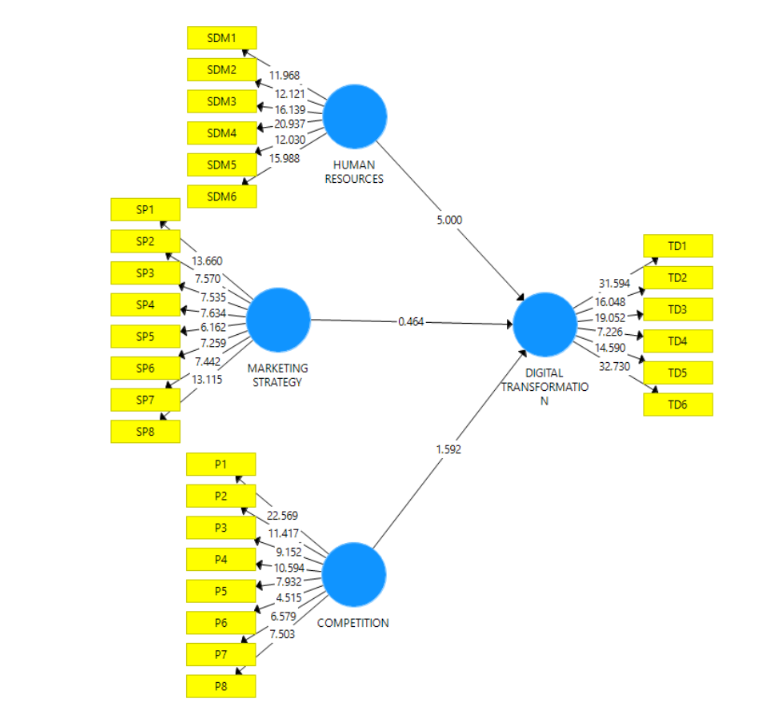
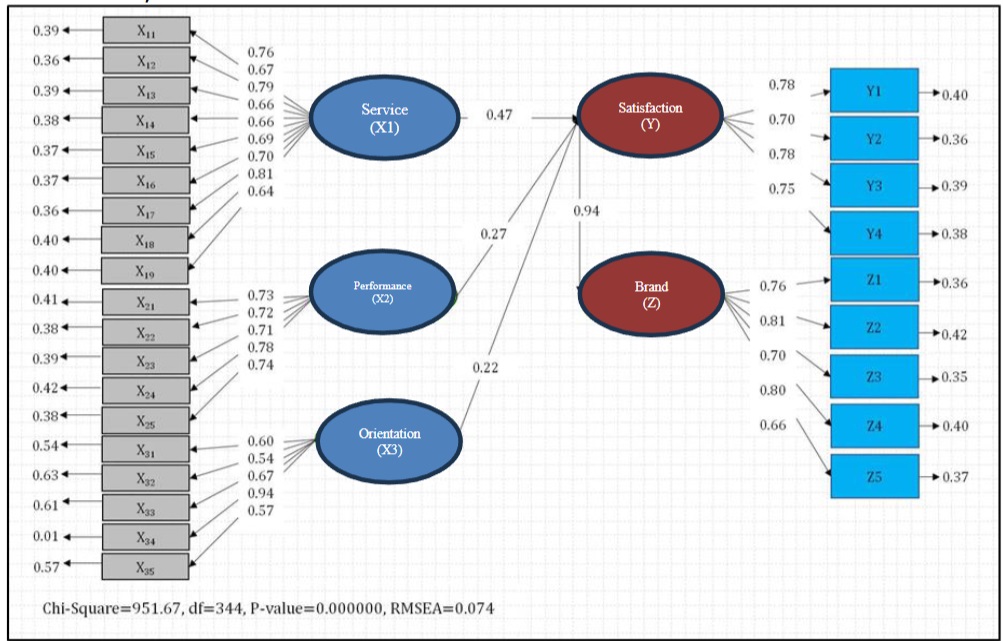
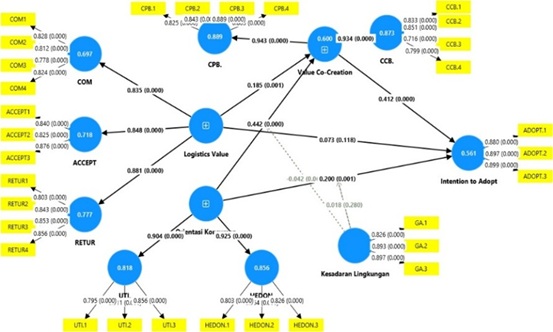
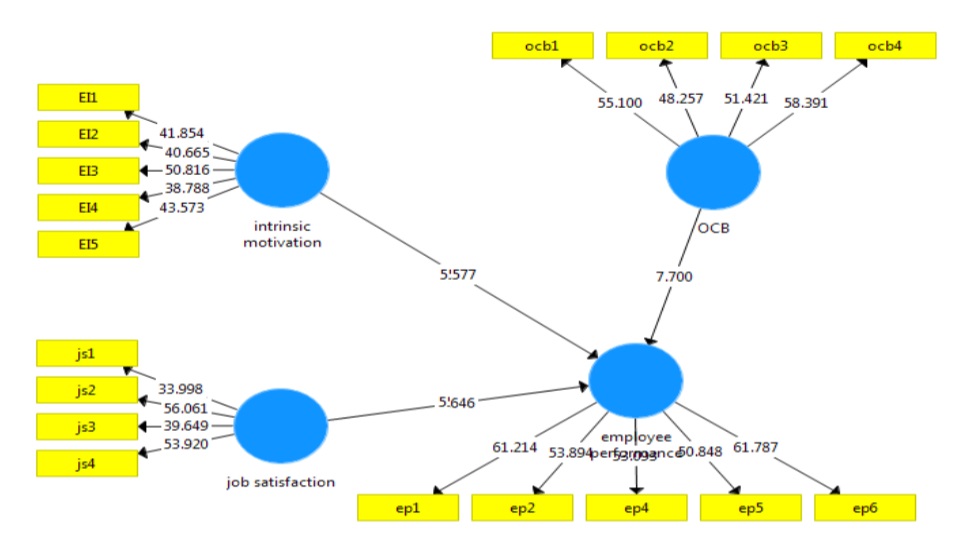
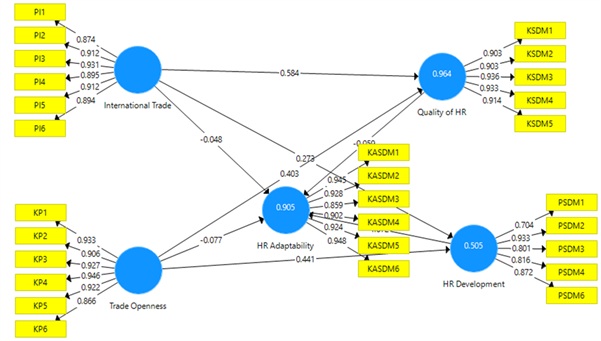
This study aims to analyze the impact of international trade on human resource development (HRD) in Indonesia by focusing on the variables of international trade (X1), trade openness (X2), HR quality (Y1), HR development (Y2), and the moderating variable of HR adaptability (Z). Data were collected from 200 respondents including business actors, workers, and stakeholders in the trade and HRD development sectors. The influence model between variables was tested using Smart PLS 3.0 to identify the relationship between international trade and trade openness on HR quality and development. The results of the study indicate that international trade (X1) and trade openness (X2) have a significant effect on the quality of human resources (Y1), but international trade does not affect human resource development (Y2). The variable of human resource adaptability (Z) is able to mediate These findings indicate that increasing international trade activities and trade openness policies can improve workforce competence through investment in education, training, and technology.
Downloads
[1] F. Barry, "Business establishment opposition to southern Ireland’s exit from the United Kingdom," Enterprise & Society, vol. 23, no. 4, pp. 984-1018, 2022.
[2] Y. P. Pratama, D. Afisena, and B. Sarosa, "Analisis proses packaging dan stuffing perusahaan furnitur lokal dalam menjaga eksistensi persaingan global (studi kasus: ud surya abadi furniture, sukoharjo, jawa tengah)," Jurnal Manajemen Industri dan Logistik, vol. 2, no. 2, pp. 159-167, 2018.
[3] R. Anissa, "Supply chain management sustainability through the performance improvement of mts-mto production system typology," Jurnal Manajemen Industri dan Logistik, vol. 1, no. 1, pp. 27-42, 2017.
[4] R. N. Caraka and A. Azis, "Pengaruh disiplin kerja dan lingkungan kerja terhadap kinerja karyawan pada bagian produksi di PT. Polindo utama kabupaten tangerang," Journal of Management and Innovation Entrepreneurship (JMIE), vol. 1, no. 2, pp. 248-254, 2024.
[5] C. Rowley and K. Jackson, Human resource management: The key concepts. Routledge, 2010.
[6] A. Purwito, "Ekspor, Impor, Sistem Harmonisasi, Nilai Pabean dan Pajak dalam Kepabeanan," 2018.
[7] N. L. L. Tarigan, T. A. Radito, and A. Purnamawati, "Pengaruh pelatihan kerja dan kompetensi terhadap kinerja karyawan," Jurnal Optimal, vol. 18, no. 2, pp. 94-104, 2021.
[8] K. Obstfeld, International economics: theory and policy. Reserve Bank, 2002.
[9] R. Promalessy, Buku Ajar Bisnis Internasional. Media Sains Indonesia, 2021.
[10] Y. Keho, "The impact of trade openness on economic growth: The case of Cote d’Ivoire," Cogent Economics & Finance, vol. 5, no. 1, p. 1332820, 2017.
[11] B. Purba, M. F. Rahmadana, M. Mukrim, and A. Krisnawati, "Pengantar Ekonomi Sumber Daya Alam dan Lingkungan," Yayasan Kita Menulis, 2023.
[12] M. H. H. Dewi, "Analisa dampak globalisasi terhadap perdagangan internasional," Ekonomia, vol. 9, no. 1, pp. 48-57, 2019.
[13] J. Rajagukguk, M. Panjaitan, A. Lumbantobing, and R. L. Halawa, "PENGARUH KEMAMPUAN ADAPTASI DAN KONSISTENSI TERHADAP KINERJA KARYAWAN PT. ISS INDONESIA AREA THAMRIN PLAZA MEDAN," Jurnal Ilmu Sosial Dan Politik, vol. 4, no. 1, pp. 102-119, 2024.
[14] W. Wirawan, "Manajemen Sumber Daya Manusia Indonesia: Teori, Psikologi, Hukum Ketenagakerjaan, Aplikasi dan Penelitian: Aplikasi dalam Organisasi Bisnis, Pemerintahan dan Pendidikan," Jakarta: Raja Grafindo Persada, 2015.
[15] J. W. Creswell and J. D. Creswell, Research design: Qualitative, quantitative, and mixed methods approaches. Sage publications, 2017.
[16] B. Pujoalwanto, "Perekonomian Indonesia tinjauan historisteoritisdan empiris," 2014.
[17] S. Sugiyono, "Metode penelitian kuantitatif, kualitatif, R&D," Bandung: Alfabeta, vol. 1, no. 11, 2016.
[18] I. Ghozali and H. Latan, "Partial Least Squares Konsep Teknik dan Aplikasi dengan Program Smart PLS 3.0," Semarang: Universitas Diponegoro Semarang, 2015.
[19] E. Fitriani, "Analisis pengaruh perdagangan internasional terhadap pertumbuhan ekonomi indonesia," JURISMA: Jurnal Riset Bisnis & Manajemen, vol. 9, no. 1, pp. 17-26, 2019.
Copyright (c) 2025 Riski Eko Ardianto, Rahmat Hidayat

This work is licensed under a Creative Commons Attribution 4.0 International License.
JMIL Jurnal Manajemen Industri dan Logistik (Journal of Industrial and Logistics Management) is an Open Access Journal. The authors who publish the manuscript in JMIL Jurnal Manajemen Industri dan Logistik agree to the following terms:

JMIL Jurnal Manajemen Industri dan Logistik is licensed under a Creative Commons Attribution 4.0 International License. This permits anyone to copy, redistribute, remix, transmit and adapt the work provided the original work and source is appropriately cited.
This means:
(1) Under the CC-BY license, authors retain ownership of the copyright for their article, but authors grant others permission to use the content of publications in JMIL Jurnal Manajemen Industri dan Logistik in whole or in part provided that the original work is properly cited. Users (redistributors) of JMIL Jurnal Manajemen Industri dan Logistik are required to cite the original source, including the author's names, JMIL Jurnal Manajemen Industri dan Logistik as the initial source of publication, year of publication, volume number, issue, and Digital Object Identifier (DOI); (2) Authors grant JMIL Jurnal Manajemen Industri dan Logistik the right of first publication. Although authors remain the copyright owner.