Digital Marketing, Service Quality, and Customer Loyalty in Indonesian Retail with the Moderating Role of Consumer Lifestyle

Downloads
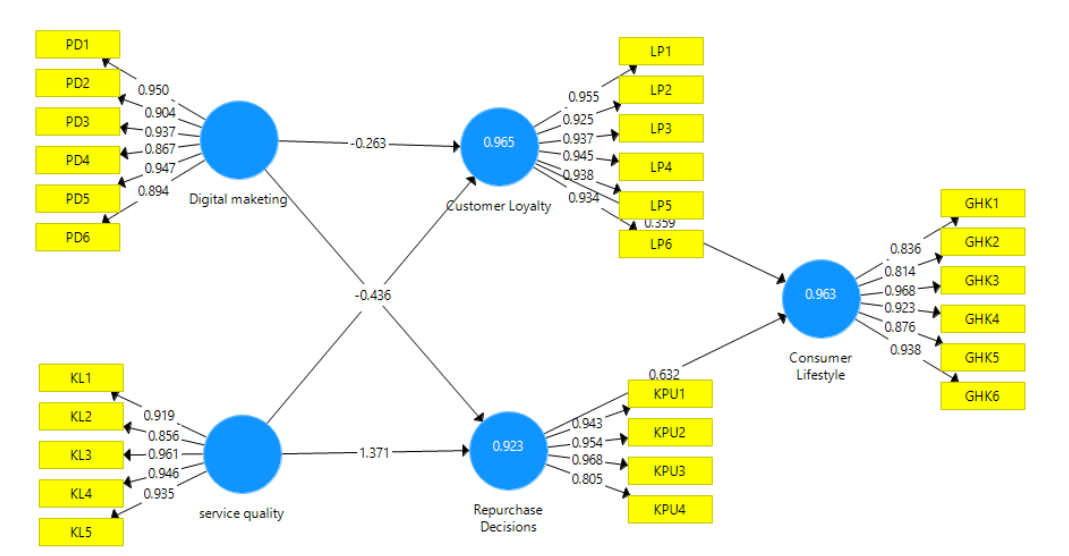
This research aims to analyze the influence of digital marketing strategies and service quality on customer loyalty and repeat purchase decisions in the retail industry in Indonesia with the moderating role of consumer lifestyle. This research uses quantitative methods with descriptive and explanatory approaches. survey research methods. The technique used in this research was purposive sampling. The research results show that the digital marketing variable has no significant effect on customer loyalty at retail companies in Indonesia, service quality has a positive and significant effect on customer loyalty at retail companies in Indonesia, digital marketing and service quality has a positive and significant effect on repurchase decisions at retail companies in Indonesia, but customer loyalty has no effect on consumer lifestyles, and repurchase decisions have a positive and significant effect on consumer lifestyles.
Downloads
[1] A. Anggraeni and A. T. Silalahi, “Retailing in Indonesia: A Deeper Look Into the World’s Growing Market,” in Global challenges and strategic disruptors in Asian businesses and economies, IGI Global, 2021, pp. 214–223.
[2] V. Sima, I. G. Gheorghe, J. Subić, and D. Nancu, “Influences of the industry 4.0 revolution on the human capital development and consumer behavior: A systematic review,” Sustainability, vol. 12, no. 10, p. 4035, 2020.
[3] T. V. Pogodina, N. L. Udaltsova, and A. V. Filushina, “Paradigm shift in technological development of socio-economic system in the context of digital transformation,” J. Adv. Res. Law Econ., vol. 10, no. 2 (40), pp. 653–662, 2019.
[4] B. M. Sopha, A. Arvianto, and B. Tjahjono, “Survival strategies of traditional retailers during the COVID-19 pandemic: Some insights from a developing country,” J. Ind. Eng. Manag., vol. 15, no. 2, pp. 185–201, 2022.
[5] V. Shankar et al., “How technology is changing retail,” J. Retail., vol. 97, no. 1, pp. 13–27, 2021.
[6] D. F. Rizki, N. Supriadi, and others, “Comparison of Alfamart and Indomaret Supply Chain Efficiency in Handling Consumer Demand in Indonesia,” Am. J. Econ. Manag. Bus., vol. 3, no. 6, pp. 144–153, 2024.
[7] S. J. Raharja, H. A. Muhyi, and D. Adiprihadi, “Contribution of the retail sector towards city economy: Study in Bandung City, Indonesia,” Rev. Integr. Bus. Econ. Res., vol. 10, pp. 19–32, 2021.
[8] D. McGruer, Dynamic digital marketing: Master the world of online and social media marketing to grow your business. John Wiley & Sons, 2020.
[9] B. Mróz, “Consumer shopping behaviours on social media platforms: Trends, challenges, business implications,” in Disruptive Platforms, Routledge, 2021, pp. 113–129.
[10] M. G. V. M. C. Sridevi, M. A. J. D. P. V Gurunath, and K. Yasoda, “Essential Strategies for Successful Digital Marketing,” Corros. Manag. ISSN 1355-5243, vol. 34, no. 2, pp. 100–108, 2024.
[11] N. Nasti, A. H. Lubis, and A. R. MS, “Analysis of the Influence of Digital Marketing on Increasing Customer Loyalty in the Industrial Era 4.0.,” Int. J. Econ., vol. 3, no. 2, 2024.
[12] I. K. Arslan, “The importance of creating customer loyalty in achieving sustainable competitive advantage,” Eurasian J. Bus. Manag., vol. 8, no. 1, pp. 11–20, 2020.
[13] S. Sabil, A. Djakasaputra, B. A. Bangkara, S. O. Manullang, P. Hendriarto, and others, “Understanding Business Management Strategies in Enhancing Profitable and Sustainable SMEs,” J. Manaj. Ind. dan Logistik, vol. 6, no. 1, pp. 112–131, 2022.
[14] J. S. Chauhan, “Brand Loyalty and Its Impact on Repeat Purchase Behaviour of Customers: A Cross-Sectional Study in the FMCG Context,” Psychol. Educ., vol. 55, no. 1, pp. 684–692, 2023.
[15] U. K. Suganda, Y. Priadi, and others , “Improving customer loyalty through customer experience, price attractiveness, and customer relationship management,” J. Manaj. Ind. dan Logistik, vol. 7, no. 1, pp. 195–204, 2023.
[16] I. Amalia, “Pengaruh Kualitas Produk, Brand Image, dan Social Media Marketing Terhadap Loyalitas Pelanggan Lovable Hijab Jepara Dalam Perspektif Ekonomi Islam,” IAIN KUDUS, 2022.
[17] M. W. Ariyanto and R. D. Astuti, “Analysis of the Effect of Service Quality Dimensions, Perceived Value, and Trust on Customers of Delivery Services through E-commerce,” J. Ind. Manag. Logist., vol. 7, no. 1, pp. 25–38, 2023.
[18] A. M. Abdulkadir, “Psychological, functional, and social factors influencing the purchasing decision of circular economy products: Case Resq-Club,” 2024.
[19] T. Zulfikar, I. Aprianti, E. Rachmawati, and others, “Digital marketing and brand image to increase consumer purchase interest,” J. Manaj. Ind. dan Logistik, vol. 6, no. 1, pp. 21–29, 2022.
[20] O. G. Idowu-Mogaji and C. C. Eze, “Psychosocial Factors Affecting the Consumer Perception,” in Consumer Perceptions and Food, Springer, 2024, pp. 699–725.
[21] M. R. Pugu, S. Riyanto, and R. N. Haryadi, Metodologi Penelitian; Konsep, Strategi, dan Aplikasi. PT. Sonpedia Publishing Indonesia, 2024.
[22] M. S. Priadana and D. Sunarsi, Metode penelitian kuantitatif. Pascal Books, 2021.
[23] Y. Haji-Othman and M. S. S. Yusuff, “Assessing reliability and validity of attitude construct using partial least squares structural equation modeling,” Int J Acad Res Bus Soc Sci, vol. 12, no. 5, pp. 378–385, 2022.
[24] N. Ardi and others, “Structural equation modelling-partial least square to determine the correlation of factors affecting poverty in Indonesian provinces,” in IOP Conference Series: Materials Science and Engineering, 2020, vol. 846, no. 1, p. 12054.
Copyright (c) 2025 Erlina Puspitaloka Mahadewi, Zairil Zairil, Arnastya Iswara Sanantagraha, Suryari Purnama

This work is licensed under a Creative Commons Attribution 4.0 International License.
JMIL Jurnal Manajemen Industri dan Logistik (Journal of Industrial and Logistics Management) is an Open Access Journal. The authors who publish the manuscript in JMIL Jurnal Manajemen Industri dan Logistik agree to the following terms:

JMIL Jurnal Manajemen Industri dan Logistik is licensed under a Creative Commons Attribution 4.0 International License. This permits anyone to copy, redistribute, remix, transmit and adapt the work provided the original work and source is appropriately cited.
This means:
(1) Under the CC-BY license, authors retain ownership of the copyright for their article, but authors grant others permission to use the content of publications in JMIL Jurnal Manajemen Industri dan Logistik in whole or in part provided that the original work is properly cited. Users (redistributors) of JMIL Jurnal Manajemen Industri dan Logistik are required to cite the original source, including the author's names, JMIL Jurnal Manajemen Industri dan Logistik as the initial source of publication, year of publication, volume number, issue, and Digital Object Identifier (DOI); (2) Authors grant JMIL Jurnal Manajemen Industri dan Logistik the right of first publication. Although authors remain the copyright owner.