An Integrated Framework for MRO Risk Mitigation Beyond Single Dimension Classification in The Upstream Oil and Gas Sector

Downloads
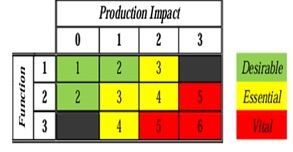
Upstream oil and gas companies face simultaneous MRO inventory stockouts and overstock, reflecting misallocation rather than resource scarcity. Existing classification methods – ABC (value), VED (criticality), and ADI-CV (demand pattern) – each address only one dimension, leaving residual risk that an integrated framework can eliminate. This study applies a combined ABC-VED-ADI-CV approach to 90 MRO items at an Indonesian upstream company using 12 months of transactional data and structured expert interviews. ABC identified Class A (6% of items with 80% of cost); VED classified 54% as Vital; ADI-CV found 96% exhibiting lumpy demand, confirming that conventional forecasting is inappropriate for virtually the entire portfolio. Integrating all three dimensions identified three tubing items as highly critical – Class A, Vital, and Lumpy – whose stockout triggers immediate well shutdown. The framework offers practitioners a replicable prioritisation tool for procurement, safety stock, and supplier management.
Andian Ari Istiningrum, Politeknik Energi dan Mineral Akamigas
 holds a Master of Commerce in Accounting from The University of Queensland, Australia, in 2010. She also received her bachelor's degree in Accounting from Universitas Gadjah Mada, Indonesia, in 2000. She is currently an associate professor at Politeknik Energi dan Mineral Akamigas in Cepu, Indonesia. Her research includes management and financial accounting. She can be contacted at email: andian.istiningrum@esdm.go.id or andian.istiningrum@gmail.com.
The Author Contribution is: Conceptualization, Methodology, Validation, Formal Analysis, Writing-Original Draft, Writing – Review & Editing.
Dhanang Resnamurti, PT Pertamina EP Cepu
 received the MBA degree in business administration and operations management from the School of Business and Management, Institut Teknologi Bandung (ITB), Indonesia. He is currently studying for his doctoral degree in management science at Universitas Pembangunan Nasional Veteran Jawa Timur, Indonesia. He is also a Supply Chain Manager at PT Pertamina EP Cepu, Indonesia. His research interest is in management leadership.
The Author Contribution is: Data Resources, Data Curation
Chhya Pang, Cambodia Logistics Association
 holds a master's degree in social and solidarity economy as well as a master's degree in entrepreneurship and project management from the University of Lumiere Lyon, France, and the Royal University of Law and Economics, Phnom Penh, Cambodia. He also received his bachelor's in general management in 2006. He is currently working as a trainer and speaker at various national and international seminars and training programs. He is a member of the Cambodia Logistics Association.
The Author Contribution is: Supervision
Nur Ardiansah, Politeknik Energi dan Mineral Akamigas
 holds a master's degree in logistics and supply chain, industrial engineering in 2024 from Institut Teknologi Sepuluh November, Indonesia. He also received his bachelor's degree in Oil and Gas Logistics from Politeknik Energi dan Mineral Akamigas, Indonesia, in 2018. He is currently working as an Educator Laboratory Analyst, and his research interests include logistics in oil and gas.
The Author Contribution is: Project Administration
Downloads
[1] D. Karyati, “Analisis pengendalian persediaan bahan baku dengan menggunakan metode Economic Order Quantity (EOQ) pada CV. Citra Sari Makassar Asdi1,” Jurnal Profitability Fakultas Ekonomi Dan Bisnis, vol. 1, no. 1, pp. 89–103, 2017.
[2] M. Siponen, H. Haapasalo, and J. Harkonen, “Maintenance, repair, and operations inventory reduction and operational development,” International Journal of Industrial and Systems Engineering, vol. 32, no. 1, pp. 1–31, 2019.
[3] J. Chen, O. Gusikhin, W. Finkenstaedt, and Y.-N. Liu, “Maintenance, repair, and operations parts inventory management in the era of industry 4.0,” IFAC-PapersOnLine, vol. 52, no. 13, pp. 171–176, 2019.
[4] A. Bacchetti and N. Saccani, “Spare parts classification and demand forecasting for stock control: Investigating the gap between research and practice,” Omega, vol. 40, no. 6, pp. 722–737, 2012.
[5] S. Bhalla, E. Alfnes, H.-H. Hvolby, and F. Sgarbossa, “Advances in spare parts classification and forecasting for inventory control: A literature review,” IFAC-PapersOnLine, vol. 54, no. 1, pp. 982–987, 2021.
[6] N. Sakib, “The application of the inventory models to manage and control overstocking in the production system,” 2021. [Online]. Available: https://www.researchgate.net/publication/355673973_The_application_of_the_inventory_models_to_manage_and_control_overstocking_in_the_production_system
[7] D. K. Meena and J. Mathaiyan, “Unveiling supply chain efficiency: exploring ABC-VED analysis studies on drug inventory management in India,” Int J Basic Clin Pharmacol, vol. 13, no. 4, pp. 563–567, 2024.
[8] H. Y. Amer and M. K. Jawad, “Inventory analysis using the ABC-Ved Matrix-applied research in Al-Zawraa State Company,” International Journal of Professional Business Review, vol. 8, no. 5, p. 17, 2023.
[9] P. Kumar, A. John Rajan, and K. N. Balan, “VED & ABC Analysis of inventories for a wind turbine company,” Applied Mechanics and Materials, vol. 591, pp. 27–32, 2014.
[10] D. Shenoy, Problems & solutions in inventory management. Springer, 2018.
[11] O. B. Herawan, G. Baskoro, and A. T. Pratama, “Optimizing spare parts by using criticality level and replenishment policy in oil and gas industry,” in Proceedings of The Conference on Management and Engineering in Industry, 2023, pp. 24–29.
[12] F. Yılmaz, “The drug inventories evaluation of healthcare facilities using ABC and VED analyzes,” Istanbul Journal of Pharmacy, vol. 48, no. 2, pp. 43–48, 2018.
[13] D. Guslan and I. Saputra, “Analisis pengendalian inventori dengan klasifikasi ABC dan EOQ pada PT Nissan Motor Distributor Indonesia,” Jurnal Logistik Bisnis, vol. 10, no. 1, pp. 73–77, 2020.
[14] I. Amallynda and E. Wicaksono, “Strategi peramalan dan pengendalian persediaan suku cadang di industri pengolahan dan importir kayu lapis,” Go-Integratif: Jurnal Teknik Sistem Dan Industri, vol. 5, no. 01, pp. 67–83, 2024.
[15] R. Mor, A. Bhardwaj, V. Kharka, and M. Kharub, “Spare parts inventory management in warehouse: a lean approach,” International Journal of Industrial Engineering & Production Research, vol. 32, no. 2, p. 4, 2021.
[16] Z. Neu, B. Hicks, and J. Gopsill, “Operating minimally intelligent agent-based manufacturing systems across the Average demand Interval–coefficient of variation (ADI-CV) demand state space,” Production & Manufacturing Research, vol. 12, no. 1, p. 2323479, 2024.
[17] K. Hong, Y. Ren, F. Li, W. Mao, and Y. Liu, “Unsupervised anomaly detection of intermittent demand for spare parts based on dual-tailed probability,” Electronics, vol. 13, no. 1, p. 195, 2024.
[18] S. P. Kenaka, A. Cakravastia, A. Ma’ruf, and R. T. Cahyono, “Enhancing intermittent spare part demand forecasting: a novel ensemble approach with Focal Loss and SMOTE,” Logistics, vol. 9, no. 1, p. 25, 2025.
[19] V. Chawla, I. Itika, P. Singh, and S. Singh, “A fuzzy Pythagorean TODIM method for sustainable ABC analysis in inventory management,” Journal of Future Sustainability, vol. 4, no. 2, pp. 85–100, 2024.
[20] D. Pradini and R. D. Kusumastuti, “Inventory analysis using Multi-Criteria ABC and ISM Method–a case study in Indonesia’s Aviation MRO,” Quantitative Economics and Management Studies, vol. 5, no. 1, pp. 22–31, 2024.
[21] M. Taşer and M. Özban, “Improvement of drug stock management using ABC-VED analysis in a university hospital,” Clinical and Experimental Health Sciences, vol. 14, no. 3, pp. 618–624, 2024.
[22] F. Costantino, G. Di Gravio, R. Patriarca, and L. Petrella, “Spare parts management for irregular demand items,” Omega, vol. 81, pp. 57–66, 2018.
[23] J. E. Boylan and A. A. Syntetos, Intermittent demand forecasting: context, methods and applications. John Wiley & Sons, 2021.
[24] H. Verma, R. K. Sankdia, L. Lahare, and L. Dubey, “ABC-VED analysis of drugs procured in the drug store of a tertiary care teaching hospital,” Journal of Pharmacy and Bioallied Science, pp. 10–4103, 2025.
[25] A. S. Shivade and S. U. Sapkal, “Application of multi-criteria abc inventory classification approaches to gearbox manufacturing industry,” Journal of The Institution of Engineers: Series C, vol. 105, no. 2, pp. 271–297, 2024.
[26] D. A. R. Nirmala, V. Kannan, M. Thanalakshmi, S. J. P. Gnanaraj, and M. Appadurai, “Inventory management and control system using ABC and VED analysis,” Mater. Today Proc., vol. 60, pp. 922–925, 2022.
[27] Y. Khanorkar and P. V Kane, “Selective inventory classification using ABC classification, multi-criteria decision making techniques, and machine learning techniques,” Materials. Today Proceeding, vol. 72, pp. 1270–1274, 2023.
[28] B. R. Silaen, M. Nasution, and R. Muti’ah, “Implementation of the ABC Analysis to the inventory management,” International Journal of Science, Technology & Management, vol. 5, no. 4, pp. 816–825, 2024.
[29] E. Pratomo, “Model ABC Multi-Criteria Inventory Classification (MCIC) menggunakan pemrograman linear pada produk kimia,” Jurnal Manajemen Industri dan Logistik, vol. 3, no. 2, pp. 106–118, 2019.
[30] E. Mfizi, F. Niragire, T. Bizimana, and M. F. Mukanyangezi, “Analysis of pharmaceutical inventory management based on ABC-VEN analysis in Rwanda: a case study of Nyamagabe district,” Journal of Pharmaceutical Policy and Practice, vol. 16, no. 1, p. 30, 2023.
[31] E. S. Teli, C. Bhangale, K. Momin, J. Ramanand, and H. Mahajan, “Application of ABC-VED analysis for inventory control in drug store of a tertiary care hospital of North Maharashtra,” Perspectives, vol. 10, no. 2, p. 62, 2022.
[32] S. Wongmongkolrit, “The classification of criticality for spare parts by applying the ratio of production lost cost to spare parts inventory cost,” British Journal of Applied Science Technology, 2016.
[33] A. A. Syntetos and J. E. Boylan, “The accuracy of intermittent demand estimates,” International Journal of Forecasting, vol. 21, no. 2, pp. 303–314, 2005.
[34] R. Aurachman and S. P. Kenaka, “Determination of inventory periodic review policy (R, S, S) using Power Approximation Method for minimize total inventory cost in PT. OPQ,” International Journal of Innovation in Enterprise System, vol. 3, no. 01, pp. 47–52, 2019.
[35] N.H. Putri. I. Sukarno, and A. Dewabharata, “Inventory control analysis of flowline pipe (case study: PT Pertamina Hulu Rokan Field Limau), “Journal of Emerging Supply Chain, Clean Energy, and Process Engineering, vol. 1, no. 2, pp. 97-106, 2022.
[36] Dalia Saber et al., “Utilizing industrial engineering methods and strategies to determine optimal inventory levels of spare parts: A review,” Global Journal of Engineering and Technology Advances, vol. 20, no. 1, pp. 045–054, Jul. 2024.
[37] A. Gurtu, “Optimization of inventory holding cost due to price, weight, and volume of items,” Journal of Risk and Financial Management, vol. 14, no. 2, pp. 65, 2021.
[38] G. U. Uke, “Optimization models for maintenance strategies in offshore oil platforms: case insights from African operations”, “International Journal of Petrochemical Engineering and Technology, vol. 3, no. 1, pp. 1-45, 2024.
[39] P. Scarf, A. Syntetos, and R. Teunter, “Joint maintenance and spare-parts inventory models: a review and discussion of practical stock-keeping rules,” IMA Journal of Management Mathematics, vol. 35, no. 1, pp. 83–109, 2024.
[40] N. Khan, W. D. Solvang, H. Yu, and B. E. Rolland, “Towards the design of a smart warehouse management system for spare parts management in the oil and gas sector,” Frontiers in Sustainability, vol. 5, 2024.
[41] S. Ramezani and M. R. Hoseinzadeh, MRO spare parts management and inventory optimization, Cases on Optimizing the Asset Management Process, IGI Global Scientific Publishing, 2022.
[42] E. Endrianto, “Determination of emergency spare parts using the logistics and maintenance perspective on power plants,” International Journal of Emerging Trends in Engineering Research, vol. 8, no. 9, pp. 5477–5484, 2020.
[43] M. A. A. Parnon, K. A. Papadopoulou, and J. K. Sinha, “A unified framework for asset ranking based on their criticality through case studies,” International Journal of Quality & Reliability Management, vol. 42, no. 9, pp. 2561-2586, 2025.
[44] R. S. Mor, D. Kumar, S. Yadav, and S. K. Jaiswal, “Achieving cost efficiency through increased inventory leanness: Evidence from manufacturing industry,” Production Engineering Archives, vol. 27, no. 1, pp. 42–49, 2021.
[45] R. H. Teunter and L. Duncan, “Forecasting intermittent demand: a comparative study,” Journal of the Operational Research Society, vol. 60, no. 3, pp. 321–329, 2009.
Copyright (c) 2026 Andian Ari Istiningrum, Dhanang Resnamurti, Chhya Pang, Nur Ardiansah

This work is licensed under a Creative Commons Attribution 4.0 International License.
JMIL Jurnal Manajemen Industri dan Logistik (Journal of Industrial and Logistics Management) is an Open Access Journal. The authors who publish the manuscript in JMIL Jurnal Manajemen Industri dan Logistik agree to the following terms:

JMIL Jurnal Manajemen Industri dan Logistik is licensed under a Creative Commons Attribution 4.0 International License. This permits anyone to copy, redistribute, remix, transmit and adapt the work provided the original work and source is appropriately cited.
This means:
(1) Under the CC-BY license, authors retain ownership of the copyright for their article, but authors grant others permission to use the content of publications in JMIL Jurnal Manajemen Industri dan Logistik in whole or in part provided that the original work is properly cited. Users (redistributors) of JMIL Jurnal Manajemen Industri dan Logistik are required to cite the original source, including the author's names, JMIL Jurnal Manajemen Industri dan Logistik as the initial source of publication, year of publication, volume number, issue, and Digital Object Identifier (DOI); (2) Authors grant JMIL Jurnal Manajemen Industri dan Logistik the right of first publication. Although authors remain the copyright owner.