Designing a Sugarcane Based Raw Material Procurement Model for the Sugar Industry

Downloads
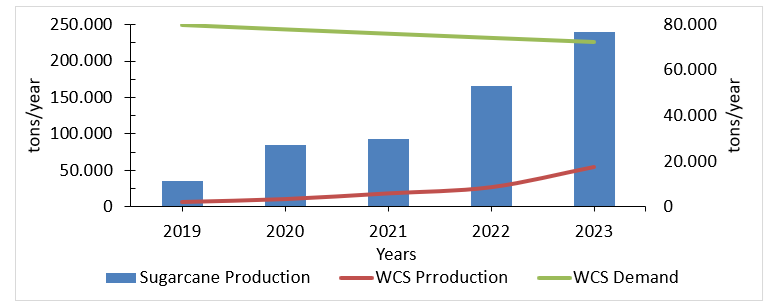
This study aims to design a system dynamics model to analyze and improve sugarcane-based procurement at PT Sukses Mantap Sejahtera (PT SMS). The model integrates three subsystems—plantation, production, and demand—to represent the interactions among supply sources, milling capacity, and regional sugar needs. Model validation using Theil's Inequality Statistics confirms the simulation results with actual data, indicating that most deviations arise from random noise rather than systematic bias. Five policy scenarios were designed to enhance system performance: (1) increasing sugarcane prices, (2) introducing subsidies for machinery rental and fertilizers, (3) improving sugarcane yield to 7.68%, (4) expanding livestock routes in the nucleus estate to 210 hectares, and (5) combining Scenarios 2, 3, and 4. Scenario 5 demonstrates the best performance, increasing sugarcane and WCS production by 4.06% and 8.32% annually. By 2030, sugarcane reaches 510,396.56 tons (+6.74%) with 68.05% milling utilization, producing 39,198.46 tons of WCS (+12.14%) and meeting 64.91% of demand in Eastern Indonesia. These results underscore the importance of integrated management, stakeholder collaboration, and Good Agricultural Practices.
Wahyu Adi Guna, Industrial Engineering and Management, IPB University
 was born in Kelantih, Central Lombok, West Nusa Tenggara, on Sept. 17, 1999. He completed his Bachelor’s degree in Agricultural Engineering at the University of Mataram, Mataram City, West Nusa Tenggara, in 2022. He is currently pursuing a Master’s degree in Agroindustrial Engineering, with a concentration in Industrial Engineering and Management, at IPB University, Bogor, West Java. His research interests include system dynamics modeling for agroindustry. He can be contacted at email: wahyugunaadi@apps.ipb.ac.id or wahyuadiguna1999@gmail.com.
Prof. Dr. Hartrisari Hardjomidjojo , Faculty of Agroindustrial Technology, IPB University
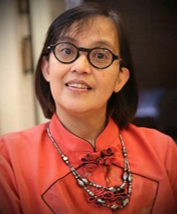 is a lecturer at the Department of Agroindustrial Technology, Faculty of Agroindustrial Technology, IPB University, Bogor, West Java. She graduated from IPB University in Agroindustrial Technology in 1984, from ENGREF, Paris, France, where she obtained her DEA in 1989, and a Ph.D. in Biosystem Engineering, majoring in System Dynamics Modeling. As a scientist, she has been involved in various projects concerning modeling of system dynamics for industries, environment, and policy analysis. Since 2023, she has been a Professor of systems engineering at IPB University. She is also a researcher at SEAMEO BIOTROP. She can be contacted at email: hartisari@apps.ipb.ac.id
Prof. Dr. Ir. Marimin , Faculty of Agroindustrial Technology, IPB University
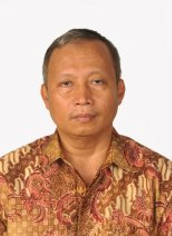 is a lecturer at the Department of Agroindustrial Technology, Faculty of Agroindustrial Technology, IPB University, Bogor, West Java. He received the B.S. degree with honors in agro-industrial technology from IPB University in 1984, the M.Sc. degree in computer science from the University of Western Ontario, Canada, in 1990, and the Ph.D. degree from the Faculty of Engineering Science, Osaka University, Japan, in 1997. Since 2003, he has been a Professor of systems engineering at IPB University. His research interests include intelligent and fuzzy expert systems, multiple-criteria decision making, intelligent decision support systems, and sustainable supply chain management. He is a member of the Institute of Electrical and Electronics Engineers (IEEE), the Indonesian Engineers Association, and the Indonesian Logistics and Supply Chain Management Association. He can be contacted at email: marimin@ipb.ac.id
Downloads
[1] M. Asrol, Marimin, Machfud, M. Yani, and Rohayati, “A Multi-Criteria Model of Supply Chain Sustainability Assessment and Improvement for Sugarcane Agroindustry,” Heliyon, vol. 10, no. 7, p. e28259, 2024, doi: 10.1016/j.heliyon.2024.e28259.
[2] BPS RI, Statistik Tebu Indonesia 2023. Jakarta: Badan Pusat Statistika, 2024.
[3] USDA, “Sugar: World Markets and Trade,” United States Departement of Agriculture. Accessed: Dec. 20, 2024. [Online]. Available: https://apps.fas.usda.gov/psdonline/circulars/sugar.pdf
[4] Pusdatin, Outlook Komoditas Tebu. Jakarta: Pusat Data dan Sistem Informasi Pertanian Sekretariat Jenderal Kementerian Pertanian, 2023.
[5] A. A. Sulaiman et al., Menjaring Investasi Meraih Swasembada Gula, 1st ed., no. 29. Jakarta: IAARD Press, 2018.
[6] I. P. C. P. Adnyana and M. S. Mohktar, “Peran Stakeholder Dalam Pemberdayaan Petani Tebu di Kabupaten Dompu Provinsi NTB,” J. Socio-Economics Agric. Agribus., vol. 13, no. 1, 2019, doi: 10.24843/SOCA.2019.v13.i01.p02.
[7] GAPGINDO, “Evaluasi Produksi Akhir Giling Gula Kristal Putih Tahun 2023,” Gabungan Produsen Gula Indonesia. Accessed: Mar. 02, 2024. [Online]. Available: https://gapgindo.com/fileman/Uploads/Documents/prod_gkp23.pdf
[8] Kemenperin, “Perkuat Kemitraan Petani Tebu, Industri Gula di Dompu Pacu Produktivitas,” Kementerian Perindustrian Republik Indonesia. Accessed: May 24, 2025. [Online]. Available: https://kemenperin.go.id/artikel/22828/Perkuat-Kemitraan-Petani-Tebu,-Industri-Gula-di-Dompu-Pacu-Produktivitas
[9] A. Rosidah, I. Irham, M. Masyhuri, and H. Perwitasari, “Sugarcane Production Efficiency: A Case Study on PTPN X Partner Farmers,” J. Manaj. dan Agribisnis, vol. 20, no. 1, pp. 56–67, 2023, doi: 10.17358/jma.20.1.56.
[10] S. K. Ruhela and M. Ruhela, “The Control of the Sugarcane Pest Top Borer (Scirpophaga nivella FAB*) through Many Approaches as Integrated Pest Management,” J. Adv. Biol. Biotechnol., vol. 27, no. 7, pp. 512–520, 2024, doi: 10.9734/jabb/2024/v27i71012.
[11] Mursiti, I. Sailah, Marimin, M. Romli, and A. Denni, “Strategi Pengembangan Sumber Daya Manusia Yang Berdaya Saing dan Berkelanjutan Pada Agroindustri Tebu: Tinjauan Literatur dan Agenda Penelitian Mendatang,” J. Teknol. Ind. Pertan., vol. 31, no. 2, pp. 129–142, 2021, doi: 10.24961/j.tek.ind.pert.2021.31.2.129.
[12] B. Desalegn, E. Kebede, H. Legesse, and T. Fite, “Sugarcane Productivity and Sugar Yield Improvement: Selecting Variety, Nitrogen Fertilizer Rate, and Bioregulator as a First-Line Treatment,” Heliyon, vol. 9, no. 4, p. e15520, 2023, doi: 10.1016/j.heliyon.2023.e15520.
[13] I. Pratiwi, H. MZ, and S. Aprilyanti, “Pemilihan Supplier Terbaik Penyedia Barang Consumable Menggunakan Metode Analytical Hierarchy Process (Studi Kasus di Departemen Pengadaan Barang PT. PUSRI),” J. Manaj. Ind. dan Logistik, vol. 2, no. 2, pp. 147–158, 2018, doi: 10.30988/jmil.v2i2.35.
[14] K. Lysons and B. Farrington, Procurement and Supply Chain Management, 10th ed. Harlow: Pearson Education Limited, 2020. doi: 10.1007/978-3-030-38948-2_101-1.
[15] D. Hayati, “Analisis Penerapan Sistem Monitoring Pemasok,” Jurnal Manajemen Industri Dan Logistik, vol. 4, no. 1, pp. 27–34, 2020, doi.org/10.30988/jmil.v4i1.245.
[16] S. DM, “The Influence Of Logistic Management, Governance, And Social Responsibility On Competitiveness And Operational Performance Of Manufacturing Companies At Makassar Industrial Estate,” J. Manaj. Ind. dan Logistik, vol. 7, no. 1, pp. 165–176, 2023, doi: 10.30988/jmil.v7i1.1180.
[17] Suripto, Machfud, M. Romli, and A. H. Y. Rosidi, “Risk Analysis and Mitigation Strategy for Sugar Cane Production Processes (Case Study: X Sugar Cane Factory - West Java),” in IOP Conference Series: Earth and Environmental Science, 2018. doi: 10.1088/1755-1315/209/1/012042.
[18] A. Gumono, N. D. Senjawati, and W. D. E. Rini, “Risk Management of Raw Material Procurement In Madukismo Sugar Factory With The House of Risk Method,” Agriekonomika, vol. 8, no. 3, pp. 725–739, 2024.
[19] R. Annisa, “Supply Chain Management Sustainability Through the Performance Improvement of Mts-Mto Production System Typology,” Jurnal Manajemen Industri Dan Logistik, vol. 1, no. 1, pp. 27–42, 2018, doi.org/10.30988/jmil.v1i1.4.
[20] Hartrisari, Sistem Dinamik: Konsep Sistem dan Pemodelan untuk Industri dan Lingkungan. Bogor: SEAMEO BIOTROP, 2007.
[21] G. Li, C. Kou, Y. Wang, and H. Yang, “System Dynamics Modelling For Improving Urban Resilience In Beijing, China,” Resour. Conserv. Recycl., vol. 161, no. May, p. 104954, 2020, doi: 10.1016/j.resconrec.2020.104954.
[22] N. Guo, F. Wu, D. Sun, C. Shi, and X. Gao, “Mechanisms of Resilience In Cities at Different Development Phases : A System Dynamics Approach,” Urban Clim., vol. 53, no. July 2023, pp. 1–17, 2024, doi: 10.1016/j.uclim.2023.101793.
[23] B. Wirjodirdjo, A. F. Fudhla, M. L. Singgih, and H. Ridho, “Driving Forces for Sustainable Development of Smallholder Sugarcane Agribusiness: A System Dynamics Approach to Circular Economy Strategies,” Agric. Resour. Econ. Int. Sci. E-Journal, vol. 11, no. 2, pp. 32–64, 2025, doi: https://doi.org/10.51599/are.2025.11.02.02.
[24] H. Mardhiana, E. Suryani, U. Asfari, and M. Nasrullah, “System Dynamic Framework: Increasing Productivity of Sugarcane To Support Sustainable Cultivation,” Sustain. Food Agric., vol. 2, no. 2, pp. 105–109, 2021, doi: 10.26480/sfna.02.2021.105.109.
[25] Hartrisari, H. Imantho, and D. Suyamto, Decision Support System on Spatial Planning for Food Security (Case Study in Jawa Barat Province). Bogor: SEAMEO BIOTROP, 2013. [Online]. Available: https://biotrop.org/files/decision support system/index.html
[26] J. D. Sterman, Business Dynamics: Systems Thinking and Modeling for a Complex World, vol. 34, no. 1. Boston: Irwin McGraw-Hill, 2000.
[27] S. Y. Tyasmoro, A. Setiawan, A. Saitama, P. N. Permatasari, and K. P. Wicaksono, “Relationship Between Compliance Level of Good Agriculture Practices with Increased Production of Sugar Cane (Saccharum officinarum L),” Int. J. Environ. Agric. Biotechnol., vol. 9, no. 2, pp. 62–71, 2024, doi: 10.22161/ijeab.
[28] D. Permadhi, S. D. Riyadi, N. Hanani, and F. Fahriyah, “Efisiensi Teknis Usahatani Tebu Rakyat (TR) Kategori Tanaman Plant Cane (PC) Pada Lahan Tegal di Kabupaten Malang, Provinsi Jawa Timur,” Indones. Sugar Res. J., vol. 4, no. 2, pp. 108–123, 2024, doi: 10.54256/isrj.v4i2.132.
Copyright (c) 2026 Wahyu Adi Guna, Prof. Dr. Hartrisari Hardjomidjojo , Prof. Dr. Ir. Marimin

This work is licensed under a Creative Commons Attribution 4.0 International License.
JMIL Jurnal Manajemen Industri dan Logistik (Journal of Industrial and Logistics Management) is an Open Access Journal. The authors who publish the manuscript in JMIL Jurnal Manajemen Industri dan Logistik agree to the following terms:

JMIL Jurnal Manajemen Industri dan Logistik is licensed under a Creative Commons Attribution 4.0 International License. This permits anyone to copy, redistribute, remix, transmit and adapt the work provided the original work and source is appropriately cited.
This means:
(1) Under the CC-BY license, authors retain ownership of the copyright for their article, but authors grant others permission to use the content of publications in JMIL Jurnal Manajemen Industri dan Logistik in whole or in part provided that the original work is properly cited. Users (redistributors) of JMIL Jurnal Manajemen Industri dan Logistik are required to cite the original source, including the author's names, JMIL Jurnal Manajemen Industri dan Logistik as the initial source of publication, year of publication, volume number, issue, and Digital Object Identifier (DOI); (2) Authors grant JMIL Jurnal Manajemen Industri dan Logistik the right of first publication. Although authors remain the copyright owner.