Selecting Green Suppliers Using a Hybrid Fuzzy BWM and IVIF-MABAC Approach in the Tropical Fruit Sector

Downloads
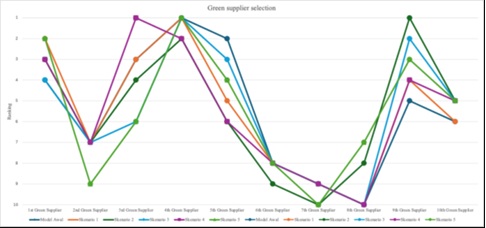
Agribusiness companies face challenges in green supplier selection due to subjective judgments and information gaps. To address these linguistic ambiguity and subjective uncertainties, this study develops a hybrid MCDM framework integrating the α-cut based Fuzzy BWM and Interval-Valued Intuitionistic Fuzzy MABAC (IVIF-MABAC). F-BWM α-cut derives stable weights from linguistic preferences, and IVIF-MABAC provides robust ranking by handling hesitancy. This approach, novel for the Indonesian tropical fruit sector, involved three experts (academic, manager, consultant) via questionnaires and FGDs. Results show Product Quality and Transparency & Traceability are critical. The 4th Green Supplier consistently achieved the highest ranking. The framework offers managers a reliable tool, enhancing sustainability and competitiveness within tropical fruit supply chains.
Dana Marsetiya Utama, Department of Industrial Engineering, Universitas Muhammadiyah Malang
 is currently a Lecturer and a Researcher in the Industrial Engineering Department, at the University of Muhammadiyah Malang Indonesia. His research interests include optimization engineering, scheduling, and modeling. He received a bachelor's degree in industrial engineering from Trunojoyo University, in 2008, and a master's degree in industrial engineering from the University of Brawijaya, in 2011. He can be contacted at at email: dana@umm.ac.id.
Krisna Hayu Dirgantara, Department of Industrial Engineering, Universitas Muhammadiyah Malang

He is a student and researcher in the Industrial Engineering Study Program at the Faculty of Engineering, Universitas Muhammadiyah Malang, Indonesia. His research focuses on green supply chain management, especially in choosing green suppliers for the tropical fruit sector. He is interested in applying sustainability principles in supply chain practices to support environmental performance and business continuity. You can contact him via email: krisnahayudirgantara@webmail.umm.ac.id.
Downloads
[1] H. Zeng, R. Y. M. Li, and L. Zeng, "Evaluating green supply chain performance based on ESG and financial indicators," Frontiers in Environmental Science, vol. 10, p. 982828, 2022, doi: https://doi.org/10.3389/fenvs.2022.982828.
[2] S. Ardra and M. K. Barua, "Sustainable supplier selection among supermarket’s fresh fruits and vegetable supply chains based on circular practices in India," Environment, Development and Sustainability, pp. 1-37, 2024, doi: https://doi.org/10.1007/s10668-024-05347-1.
[3] A. Kumar, S. K. Mangla, and P. Kumar, "A decision framework for supplier selection and order allocation for environmentally-sustainable perishable food supply chains," Annals of Operations Research, vol. 346, no. 2, pp. 1153-1185, 2025, doi: https://doi.org/10.1007/s10479-024-06413-7.
[4] A. Puška, M. Nedeljković, S. Hashemkhani Zolfani, and D. Pamučar, "Application of interval fuzzy logic in selecting a sustainable supplier on the example of agricultural production," Symmetry, vol. 13, no. 5, p. 774, 2021.
[5] C. C. Kersten, J. M. C. Kerber, J. d. S. Silva, M. Bouzon, and L. M. d. S. Campos, "Traceability in the agri-food supply chain: a new perspective under the Circular Economy approach," Production, vol. 34, p. e20240009, 2024.
[6] C.-N. Wang, T.-D. T. Pham, and N.-L. Nhieu, "Multi-layer fuzzy sustainable decision approach for outsourcing manufacturer selection in apparel and textile supply chain," Axioms, vol. 10, no. 4, p. 262, 2021.
[7] S. K. Dewi, R. Febrianti, and D. M. Utama, "An Integrated method for manufacturing Sustainability assessment in tire industry: a case study in Indonesian," International Journal of Sustainable Engineering, vol. 16, no. 1, pp. 1-12, 2023.
[8] M. Hajiaghaei-Keshteli, Z. Cenk, B. Erdebilli, Y. S. Özdemir, and F. Gholian-Jouybari, "Pythagorean fuzzy TOPSIS method for green supplier selection in the food industry," Expert Systems with Applications, vol. 224, p. 120036, 2023, doi: https://doi.org/10.1016/j.eswa.2023.120036.
[9] S. Naz, A. Tasawar, S. A. Butt, J. Diaz-Martinez, and E. De-La-Hoz-Franco, "An integrated CRITIC-MABAC model under 2-tuple linguistic cubic q-rung orthopair fuzzy information with advanced aggregation operators, designed for multiple attribute group decision-making," The Journal of Supercomputing, vol. 80, no. 19, pp. 27244-27302, 2024, doi: https://doi.org/10.1007/s11227-024-06419-9.
[10] D. M. Utama, "AHP and TOPSIS integration for green supplier selection: A case study in Indonesia," 2021 2021, vol. 1845: IOP Publishing, 1 ed., p. 012015.
[11] A. Puška, D. Božanić, M. Nedeljković, and M. Janošević, "Green supplier selection in an uncertain environment in agriculture using a hybrid MCDM model: Z-Numbers–Fuzzy LMAW–Fuzzy CRADIS model," Axioms, vol. 11, no. 9, p. 427, 2022, doi: https://doi.org/10.3390/axioms11090427.
[12] M. Yazdani et al., "A fuzzy group decision-making model to measure resiliency in a food supply chain: A case study in Spain," Socio-Economic Planning Sciences, vol. 82, p. 101257, 2022, doi: https://doi.org/10.1016/j.seps.2022.101257.
[13] J. H. Purba, D. T. Sony Tjahyani, I. P. Susila, S. Widodo, and A. S. Ekariansyah, "Fuzzy probability and α‐cut based‐fault tree analysis approach to evaluate the reliability and safety of complex engineering systems," Quality and Reliability Engineering International, vol. 38, no. 5, pp. 2356-2371, 2022, doi: https://doi.org/10.1002/qre.3080.
[14] E. Arı and M. Dursun, "An Integrated Bayesian Best–Worst Method and Consensus-Based Intuitionistic Fuzzy Evaluation Based on Distance from Average Solution Approach for Evaluating Alternative Aircraft Models from a Sustainability Perspective," Symmetry, vol. 16, no. 8, p. 1086, 2024, doi: https://doi.org/10.3390/sym16081086.
[15] A. Puška, A. Štilić, M. Nedeljković, D. Božanić, and S. Biswas, "Integrating fuzzy rough sets with LMAW and MABAC for green supplier selection in agribusiness," Axioms, vol. 12, no. 8, p. 746, 2023, doi: https://doi.org/10.3390/axioms12080746.
[16] M. Zhao, G. Wei, X. Chen, and Y. Wei, "Intuitionistic fuzzy MABAC method based on cumulative prospect theory for multiple attribute group decision making," International Journal of Intelligent Systems, vol. 36, no. 11, pp. 6337-6359, 2021, doi: https://doi.org/10.1002/int.22552.
[17] A. O. Bello and T. P. Mbhele, "A Fuzzy-AHP Multi-Criteria Decision-Making Approach for a Sustainable Supply Chain of Rice Farming Stakeholders in Edu-Patigi LGA, Kwara State, Nigeria," Sustainability, vol. 16, no. 5, p. 1751, 2024.
[18] H. M. Ratandhara and M. Kumar, "An α-cut intervals based Fuzzy Best–Worst Method for Multi-Criteria Decision-Making," Applied Soft Computing, vol. 159, p. 111625, 2024.
[19] S. Wibawa, A. D. Ekawati, B. Maryadi, N. Fitriyani, and A. Redi, "Komparasi fuzzy ahp, topsis dan smart untuk pemilihan supplier," Jurnal Manajemen Industri dan Logistik, vol. 5, no. 2, pp. 121-129, 2021.
[20] M. Amiri, M. Hashemi-Tabatabaei, M. Ghahremanloo, M. Keshavarz-Ghorabaee, E. K. Zavadskas, and A. Banaitis, "A new fuzzy BWM approach for evaluating and selecting a sustainable supplier in supply chain management," International Journal of Sustainable Development & World Ecology, vol. 28, no. 2, pp. 125-142, 2021.
[21] D. Pamučar, A. Puška, Ž. Stević, and G. Ćirović, "A new intelligent MCDM model for HCW management: The integrated BWM–MABAC model based on D numbers," Expert Systems with Applications, vol. 175, p. 114862, 2021, doi: https://doi.org/10.1016/j.eswa.2021.114862.
[22] J. Wang, Q. Cai, H. Wang, G. Wei, and N. Liao, "RETRACTED: An integrated decision-making methodology for green supplier selection based on the improved IVIF-CPT-MABAC method," Journal of Intelligent & Fuzzy Systems, vol. 44, no. 5, pp. 8535-8560, 2023.
[23] E. Aytaç Adali and A. Tuş, "Integration of Analytic Hierarchy Process and Multi Attributive Border Approximation Area Comparison for the Hybrid Vehicle Selection Problem in Intuitionistic Fuzzy Environment," Informatica, pp. 1-36, 2025.
[24] J. Huang, Y. Xu, X. Wen, X. Zhu, and E. Herrera-Viedma, "Deriving priorities from the fuzzy best-worst method matrix and its applications: A perspective of incomplete reciprocal preference relation," Information Sciences, vol. 634, pp. 761-778, 2023.
[25] S. Charlebois, N. Latif, I. Ilahi, B. Sarker, J. Music, and J. Vezeau, "Digital traceability in agri-food supply chains: A compar
Copyright (c) 2026 Dana Marsetiya Utama, Krisna Hayu Dirgantara

This work is licensed under a Creative Commons Attribution 4.0 International License.
JMIL Jurnal Manajemen Industri dan Logistik (Journal of Industrial and Logistics Management) is an Open Access Journal. The authors who publish the manuscript in JMIL Jurnal Manajemen Industri dan Logistik agree to the following terms:

JMIL Jurnal Manajemen Industri dan Logistik is licensed under a Creative Commons Attribution 4.0 International License. This permits anyone to copy, redistribute, remix, transmit and adapt the work provided the original work and source is appropriately cited.
This means:
(1) Under the CC-BY license, authors retain ownership of the copyright for their article, but authors grant others permission to use the content of publications in JMIL Jurnal Manajemen Industri dan Logistik in whole or in part provided that the original work is properly cited. Users (redistributors) of JMIL Jurnal Manajemen Industri dan Logistik are required to cite the original source, including the author's names, JMIL Jurnal Manajemen Industri dan Logistik as the initial source of publication, year of publication, volume number, issue, and Digital Object Identifier (DOI); (2) Authors grant JMIL Jurnal Manajemen Industri dan Logistik the right of first publication. Although authors remain the copyright owner.