Raw Material Logistics Performance Measurement Using OMAX Method

Downloads
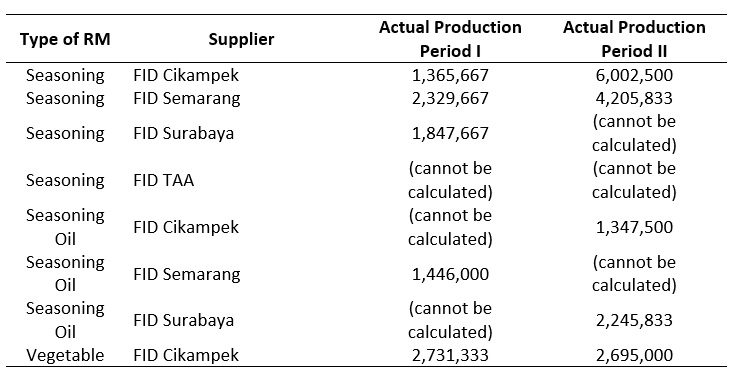
The Fast-Moving Consumer Goods [FMCG] industry plays a strategic role in the Indonesian economy, where raw material logistics management remains a key challenge directly impacting production efficiency and competitiveness. This study analyzes the logistics performance of raw material suppliers at an Instant Noodle Company to identify performance patterns and their impact on operational efficiency using the Objective Matrix (OMAX) method across three main categories: seasoning, seasoning and vegetable oil, and packaging over one year. The results reveal significant variations in supplier performance, with the seasoning category showing substantial improvements in Cikampek and Semarang facilities correlating with increased production, while Surabaya experienced a notable decline. The seasoning and vegetable oil category demonstrated stable performance despite minor production fluctuations, whereas the packaging category revealed consistent performance deterioration among key suppliers, negatively affecting production capacity. The findings indicate that supplier performance directly influences logistics efficiency and production capacity. This study recommends supplier development programs, performance monitoring systems, and supplier portfolio diversification to enhance consistency and competitiveness in the FMCG sector.
Winoto Hadi, Applied Undergraduate Study Program of Port Management and Maritime Logistics, Universitas Negeri Jakarta
 was born in Purwokerto on February 11, 1971. He is a lecturer at Universitas Negeri Jakarta with educational background in construction management, transportation, and human resource management. Actively teaching courses related to terminal operations, terminal management, and port safety. he produced various research in the fields of transportation, port management, logistics, and simulation-based digital technology as well as virtual reality. In addition to writing scientific articles in various international journals, Dr. Winoto Hadi is also productive in publishing books and innovative works registered under Intellectual Property Rights, establishing him as both a credible academic and author in the field of maritime transportation and port management.
The Author Contribution is : Conceptualization, Methodology, Investigation Resources, Writing – Original Draft, Review & Editing, Visualization, Supervision, Funding Acquisition
Vivian Karim Ladesi, Applied Undergraduate Study Program of Port Management and Maritime Logistics, Universitas Negeri Jakarta
 was born in Kendari on October 27, 1980. She is a lecturer in the Applied Bachelor's Program in Port and Maritime Logistics Management, Faculty of Engineering, Universitas Negeri Jakarta, with expertise in port management and risk management. She currently serves as the Program Coordinator and LSP-P1 UNJ assessor for the Export Cargo Handling scheme. In addition to teaching courses in port operations, risk management, export-import, and transportation and port service tariffs, she is also actively engaged in book writing, conducting research on port management, logistics, and maritime industry, and holds various professional certifications in supply chain, occupational health and safety (OHS), and procurement of goods and services.
The Author Contribution is : Methodology, Validation, Formal Analysis, Writing – Review & Editing, Funding Acquisition
Nur Azisah, Applied Undergraduate Study Program of Port Management and Maritime Logistics, Universitas Negeri Jakarta
 was born in Solo on March 1, 1998. She is a lecturer in the Applied Bachelor's Program in Port and Maritime Logistics Management at Universitas Negeri Jakarta with expertise in maritime transportation and port management. Actively teaching courses related to port management, customs, management information systems, and programming in port and logistics fields, she is also involved in research and scientific publications on smart ports, submarine pipeline protection, and port infrastructure, while actively sharing knowledge through seminars and community service activities.
The Author Contribution is: Conceptualization, Methodology, Investigation Resources, Data Curation, Writing – Original Draft, Draft Editing, Visualization, Project Administration.
Lintang Prima, Applied Undergraduate Study Program of Port Management and Maritime Logistics, Universitas Negeri Jakarta
 is a graduate of the Applied Bachelor's Program in Port and Maritime Logistics Management at Universitas Negeri Jakarta with interests in business analysis, operational management, and logistics and transportation. She currently works as a Business Analyst at PT Indofood CBP Sukses Makmur Tbk – Noodle Division, having previously held various professional positions in international sales administration, customer service, and financial administration at multinational companies and shipping industry. This cross-sectoral experience strengthens her competency in understanding the dynamics of transportation management, distribution, and supply chain, while fostering her interest in academic studies on transportation and mobility.
The Author Contribution is: Conceptualization, Validation, Formal Analysis, Investigation Resources, DataCuration, Writing – Original Draft, , Visualization
Rajendran Narayanasamy, School of Sustainable Supply Chain & Logistics, Malaysia University of Science and Technology, Petaling Jaya,Selangor
 is a Senior Lecturer and Head of Program for the MSc in Transport and Logistics and MBA in Supply Chain Management at the Malaysia University of Science and Technology. With 25 years of industry experience, he is a thougt leader in logistics and supply chain management, integrating academic rigor with practical industry insight.
The Author Contribution is : Validation, Formal Analysis, Investigation Resources, Writing – Review & Editing, Visualization, Supervision.
Downloads
[1] K. Y. H. Lim, L. Van Dang, and C.-H. Chen, “Incorporating supply and production digital twins to mitigate demand disruptions in multi-echelon networks,” Int. J. Prod. Econ., vol. 273, p. 109258, 2024, doi: https://doi.org/10.1016/j.ijpe.2024.109258.
[2] S. S. Indasari and A. Tjahyanto, “Decision Support Model in Compiling Owner Estimate for FMCGs Products from Various Marketplaces with TF-IDF and LSA-based Clustering,” Procedia Comput. Sci., vol. 234, pp. 455–462, 2024, doi: https://doi.org/10.1016/j.procs.2024.03.027.
[3] T. Zhang, T.-M. Choi, and T.-C. (Edwin) Cheng, “Competitive pricing and product strategies in the presence of consumers’ social comparisons,” Eur. J. Oper. Res., vol. 312, no. 2, pp. 573–586, 2024, doi: https://doi.org/10.1016/j.ejor.2023.06.023.
[4] P. Citra, I. Mulia, M. Farid, and E. Nurmiati, “Perancangan Electronic Supply Chain Management ( E-SCM ) pada PT . Indofood CBP Sukses Makmur TBK,” INSOLOGI J. Sains dan Teknol., vol. 1, no. 3, pp. 218–231, 2022, doi: 10.55123/insologi.v1i3.407.
[5] A. D. Wibowo, “MODIFIKASI MANAJEMEN INVENTORI GUDANG DALAM IMPLEMENTASI LEAN WAREHOUSING: SEBUAH STUDI KASUS PADA INDUSTRI FMCG,” J. Manaj. Ind. dan Logistik, vol. 04, no. 02, pp. 116–129, 2020.
[6] Z. Raza, J. Woxenius, C. A. Vural, and M. Lind, “Digital transformation of maritime logistics: Exploring trends in the liner shipping segment,” Comput. Ind., vol. 145, p. 103811, 2023, doi: https://doi.org/10.1016/j.compind.2022.103811.
[7] J. Wang, F. He, M. Chen, and J. Liu, “A review of game theory to maritime supply chain: A competitive and cooperative perspective,” Transp. Policy, vol. 162, pp. 364–378, 2025, doi: https://doi.org/10.1016/j.tranpol.2024.12.013.
[8] E. Suzanne, N. Absi, and V. Borodin, “Towards circular economy in production planning: Challenges and opportunities,” Eur. J. Oper. Res., vol. 287, no. 1, pp. 168–190, 2020, doi: https://doi.org/10.1016/j.ejor.2020.04.043.
[9] S. Pramudiawardani, Z. Abidin, A. N. Hidayanto, N. Fitriah, and A. Budi, “Sustainability Supply Chain Management in Indonesia : A Systematic Review,” Proc. Int. Conf. Inf. Syst. Technol., no. Conrist 2019, pp. 105–112, 2020, doi: 10.5220/0009906401050112.
[10] V. S. Lukinskiy, M. M. Pimonenko, M. Paajanen, and T. G. Shulzhenko, “DEVELOPMENT OF METHODOLOGY AND TOOLS FOR COMPARATIVE ASSESSMENT OF OPERATIONAL EFFICIENCY OF KPI-BASED LOGISTICAL INFRASTRUCTURE FACILITIES,” Transp. Telecommun., vol. 14, no. 3, pp. 223–229, 2013, doi: 10.2478/ttj-2013-0019.
[11] H. Subagyo, P. Ricardianto, E. B. Setiawan, and ..., “Supply Chain Performance Measurement of Logistic Business Using SCOR Model in the Indonesian Main Ports,” Int. J. …, 2022.
[12] H.-W. Kim, Y.-S. Choi, and J.-E. Lee, “A study on fuzzy-AHP analysis for carbon neutrality in container terminals in Korea,” Asian J. Shipp. Logist., vol. 41, no. 2, pp. 90–98, 2025, doi: https://doi.org/10.1016/j.ajsl.2025.02.003.
[13] R. M. Sumaila et al., “PENERAPAN METODE OMAX UNTUK ANALISIS PRODUKTIVITAS DI PT . EQUIPORT INTI INDONESIA BITUNG,” J. Tekno Mesin, vol. 10, pp. 16–21, 2023.
[14] N. Stifany and J. Shofa, “Integrasi ANP dan OMAX dalam Pengukuran Kinerja Rantai Pasok Industri Kimia,” Profisiensi, vol. 8, no. 2, pp. 94–104, 2020.
[15] S. Saetta and V. Caldarelli, “How to increase the sustainability of the agri-food supply chain through innovations in 4.0 perspective: a first case study analysis,” Procedia Manuf., vol. 42, pp. 333–336, 2020, doi: https://doi.org/10.1016/j.promfg.2020.02.083.
[16] Ismartaya, T. Kartini, Safuan, I. N. Halizah, and D. Apriyadi, “The Influence Of Organizational Culture And Work Environment On Employee Performance With Work Motivation As A Variable Intervening,” J. Manaj. Ind. dan Logistik, vol. 7, pp. 347–360, 2023.
[17] H. Hanafiah, R. Palupi, A. S. Ghaniyyah, and G. R. Nugraha, “Assessing the Impact of Multilane Free Flow on Vehicle Operating Costs and Logistics Efficiency in Indonesia Using SWOT Analysis Approach,” J. Manaj. Ind. dan Logistik, vol. 10, no. 1, pp. 1–20, 2026.
[18] A. A. Fink, M. Klöckner, T. Räder, and S. M. Wagner, “Supply chain management accelerators: Types, objectives, and key design features,” Transp. Res. Part E Logist. Transp. Rev., vol. 164, p. 102728, 2022, doi: https://doi.org/10.1016/j.tre.2022.102728.
[19] R. F. Suryawan, Y. Pahala, T. Maianto, and W. D. Febrian, “Enhancing Customer Loyalty Through Customer Satisfaction of Service Quality and Brand Image in Travel Companies,” J. Manaj. Ind. dan Logistik, vol. 9, no. 1, pp. 54–69, 2025.
[20] M. Hartina, B. Sembiring, W. N. Ak, and T. Hernawati, “Analisis Pengukuran Produktivitas Menggunakan Metode Pendekatan Objective Matrix ( OMAX ) pada Proses Produksi Air Minum di PT Tirta Investama Langkat,” Blend Sci., vol. 3, no. 3, pp. 268–285, 2025.
[21] Soekrisman, “PENGARUH GREEN PRODUCT & PRAKTEK GREEN BUSINESS PERUSAHAAN TERHADAP KEPUTUSAN PEMBELIAN PRODUK DAUR ULANG PLASTIK DI JAKARTA, INDONESIA (JABODETABEK),” Jurnal Ekonomi Perusahaan, vol. 27, no. 1. Institut Bisnis dan Informatika Kwik Kian Gie, 2020. doi: 10.46806/jep.v27i1.706.
[22] W. Torbacki and K. Kijewska, “Identifying Key Performance Indicators to be used in Logistics 4.0 and Industry 4.0 for the needs of sustainable municipal logistics by means of the DEMATEL method,” Transp. Res. Procedia, vol. 39, pp. 534–543, 2019, doi: https://doi.org/10.1016/j.trpro.2019.06.055.
[23] L. Barasa et al., “Developing Customer-Centric Marketing Strategies for Maritime Logistics,” E3S Web Conf., vol. null, p. null, 2024, doi: 10.1051/e3sconf/202457102013.
[24] A. A. Rakhmasari, T. Djatna, O. Suparno, and M. S. Rusli, “A sensitivity analysis of stochastic programming for reverse logistic of herbs agro-industry: a case study of herbs logistic in Indonesia,” IOP Conference Series: Earth and Environmental Science, vol. 472, no. 1. IOP Publishing, p. 12055, 2020. doi: 10.1088/1755-1315/472/1/012055.
[25] G. Santos, F. Murmura, and L. Bravi, “Developing a model of vendor rating to manage quality in the supply chain,” Int. J. Qual. Serv. Sci., vol. 11, no. 1, pp. 34–52, Jan. 2019, doi: 10.1108/IJQSS-06-2017-0058.
[26] P. Ravula, “Impact of delivery performance on online review ratings : the role of temporal distance of ratings,” J. Mark. Anal., vol. 11, no. 2, pp. 149–159, 2025, doi: 10.1057/s41270-022-00168-5.
Copyright (c) 2026 Winoto Hadi, Vivian Karim Ladesi, Nur Azisah, Lintang Prima, Rajendran Narayanasamy

This work is licensed under a Creative Commons Attribution 4.0 International License.
JMIL Jurnal Manajemen Industri dan Logistik (Journal of Industrial and Logistics Management) is an Open Access Journal. The authors who publish the manuscript in JMIL Jurnal Manajemen Industri dan Logistik agree to the following terms:

JMIL Jurnal Manajemen Industri dan Logistik is licensed under a Creative Commons Attribution 4.0 International License. This permits anyone to copy, redistribute, remix, transmit and adapt the work provided the original work and source is appropriately cited.
This means:
(1) Under the CC-BY license, authors retain ownership of the copyright for their article, but authors grant others permission to use the content of publications in JMIL Jurnal Manajemen Industri dan Logistik in whole or in part provided that the original work is properly cited. Users (redistributors) of JMIL Jurnal Manajemen Industri dan Logistik are required to cite the original source, including the author's names, JMIL Jurnal Manajemen Industri dan Logistik as the initial source of publication, year of publication, volume number, issue, and Digital Object Identifier (DOI); (2) Authors grant JMIL Jurnal Manajemen Industri dan Logistik the right of first publication. Although authors remain the copyright owner.