Improving Industrial Chemical Supply Chain Reliability through Customer Feedback in the Pulp and Paper Sector

Downloads
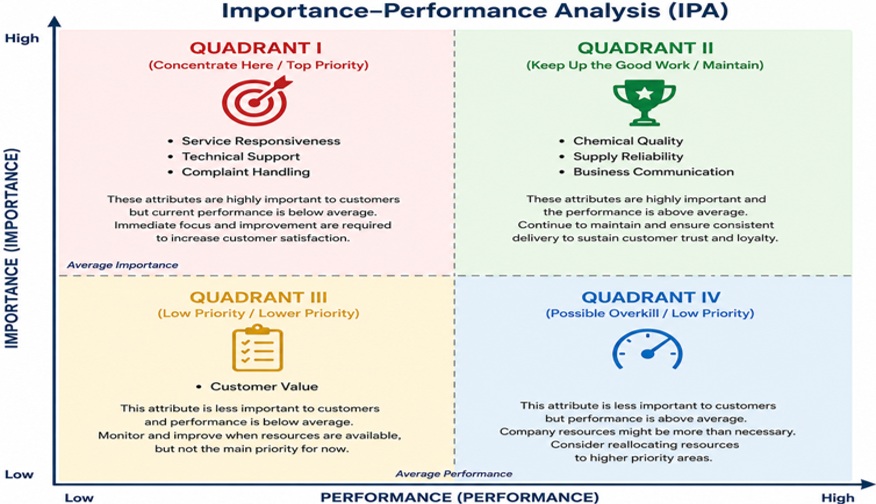
Increasing competition in Indonesia’s pulp and paper industry requires industrial chemical suppliers to strengthen supply chain performance and customer relationships. This study evaluates customer perceptions of chemical quality, supply reliability, service responsiveness, technical support, complaint handling, business communication, and customer value using the Customer Satisfaction Index (CSI) and Importance Performance Analysis (IPA). Data were collected through questionnaires distributed to customers from eight pulp and paper companies in Indonesia. The results show that chemical quality, supply reliability, and business communication are the main factors supporting supply chain reliability and customer satisfaction. Meanwhile, service responsiveness, technical support, and complaint handling still require improvement due to their influence on operational effectiveness and customer experience. The findings provide practical insights for improving service quality, strengthening customer value, and enhancing long-term competitiveness in the industrial chemical supply chain sector.
Diky Iskandar, Jenderal Achmad Yani University
 Diky Iskandar holds a Bachelor of Industrial Engineering (S.T). He is a student at Jenderal Achmad Yani University, Department of Master of Technology Management, Faculty of Manufacturing Technology. The author holds a student position in the institution. The author is interested in management disciplines, with a focus on strategic marketing and the marketing industry. Other areas of interest include marketing strategy and industry-based marketing analysis. He can be contacted at email: diskand7@gmail.com
The Author Contribution are: contributed to conceptualization, methodology, data curation, formal analysis, investigation, and writing – original draft.
Evan Nugraha, Jenderal Achmad Yani University
 Dr. Evan Nugraha graduated from Pasundan University in 2019 with a doctorate in management science. At Jenderal Achmad Yani University, Department of Master of Technology Management, Faculty of Manufacturing Technology, the author holds a permanent lecturer position. The author is interested in management disciplines, with a focus on operations management. Supply chain management, logistics management, six sigma and quality management are some other areas. The author's email address is: evannugraha@lecture.unjani.ac.id
The Author Contribution are: as the corresponding author, contributed to supervision, project administration, validation, writing – review and editing, funding acquisition, and resources.
Oviyan Patra, Jenderal Achmad Yani University
 Dr. Oviyan Patra is the Head of the Master of Technology Management Study Program at Universitas Jenderal Achmad Yani (Unjani), Faculty of Manufacturing Technology. The author holds an academic leadership position within the program. The author is interested in management disciplines, with a focus on technology management, innovation management, and industrial systems. Other areas of expertise include operational strategy, digital transformation in industry, and applied management systems. He can be contacted at email: oviyan.patra@lecture.unjani.ac.id
The Author Contribution are: contributed to software development, visualization, investigation, data curation, and formal analysis.
Prof. Dr. Jol Stoffers, Maastricht University, School of Business and Economics, the Netherlands
 Prof. Dr. Jol Stoffers is graduated from Radboud University, the Netherlands, with a doctorate in Management Science. He currently serves as Professor and Head of the Research Centre for Employability at Zuyd University of Applied Sciences, the Netherlands, and is affiliated with Maastricht University, School of Business and Economics, the Netherlands, as a research fellow and Editorial Board member. His research interests focus on human resource management, employability, organizational behavior, leadership, sustainability, and innovative work behavior. He can be contacted at email: jol.stoffers@zuyd.nl
The Author Contribution are: contributed to conceptualization, supervision, validation, writing – review and editing, and providing academic insights related to management and organizational perspectives.
Downloads
[1] D. D. Furszyfer Del Rio et al., “Decarbonizing the pulp and paper industry: A critical and systematic review of sociotechnical developments and policy options,” Renew. Sustain. Energy Rev., vol. 167, no. April, p. 112706, 2022, doi: 10.1016/j.rser.2022.112706.
[2] J. Almanza Floyd, I. D’Adamo, S. Fosso Wamba, and M. Gastaldi, “Competitiveness and sustainability in the paper industry: The valorisation of human resources as an enabling factor,” Comput. Ind. Eng., vol. 190, no. March, p. 110035, 2024, doi: 10.1016/j.cie.2024.110035.
[3] T. E. Oladimeji, M. Oyedemi, M. E. Emetere, O. Agboola, J. B. Adeoye, and O. A. Odunlami, “Review on the impact of heavy metals from industrial wastewater effluent and removal technologies,” Heliyon, vol. 10, no. 23, p. e40370, 2024, doi: 10.1016/j.heliyon.2024.e40370.
[4] L. Malehmirchegini and A. J. Chapman, “Strategies for achieving carbon neutrality within the chemical industry,” Renew. Sustain. Energy Rev., vol. 217, no. October 2024, p. 115762, 2025, doi: 10.1016/j.rser.2025.115762.
[5] M. Banka et al., “Understanding corporate concerns. Barriers and challenges in corporate–start-up collaboration,” J. Open Innov. Technol. Mark. Complex., vol. 10, no. 4, p. 100388, 2024, doi: 10.1016/j.joitmc.2024.100388.
[6] G. Agag et al., “Understanding the link between customer feedback metrics and firm performance,” J. Retail. Consum. Serv., vol. 73, no. February, p. 103301, 2023, doi: 10.1016/j.jretconser.2023.103301.
[7] A. H. Tahir, M. Adnan, and Z. Saeed, “The impact of brand image on customer satisfaction and brand loyalty: A systematic literature review,” Heliyon, vol. 10, no. 16, p. e36254, 2024, doi: 10.1016/j.heliyon.2024.e36254.
[8] M. Nilashi et al., “The nexus between quality of customer relationship management systems and customers’ satisfaction: Evidence from online customers’ reviews,” Heliyon, vol. 9, no. 11, p. e21828, 2023, doi: 10.1016/j.heliyon.2023.e21828.
[9] B. K. Sovacool, M. Bazilian, S. Griffiths, J. Kim, A. Foley, and D. Rooney, “Decarbonizing the food and beverages industry: A critical and systematic review of developments, sociotechnical systems and policy options,” Renew. Sustain. Energy Rev., vol. 143, no. February, p. 110856, 2021, doi: 10.1016/j.rser.2021.110856.
[10] J. Shin, Y. J. Kim, S. Jung, and C. Kim, “Product and service innovation: Comparison between performance and efficiency,” J. Innov. Knowl., vol. 7, no. 3, p. 100191, 2022, doi: 10.1016/j.jik.2022.100191.
[11] A. L. Roggeveen and S. Rosengren, “From customer experience to human experience: Uses of systematized and non-systematized knowledge,” J. Retail. Consum. Serv., vol. 67, no. February, p. 102967, 2022, doi: 10.1016/j.jretconser.2022.102967.
[12] I. Farida and D. Setiawan, “Business Strategies and Competitive Advantage: The Role of Performance and Innovation,” J. Open Innov. Technol. Mark. Complex., vol. 8, no. 3, p. 163, 2022, doi: 10.3390/joitmc8030163.
[13] T. G. Walmsley et al., “Hybrid renewable energy utility systems for industrial sites: A review,” Renew. Sustain. Energy Rev., vol. 188, no. February, 2023, doi: 10.1016/j.rser.2023.113802.
[14] A. Purmonen, E. Jaakkola, and H. Terho, “B2B customer journeys: Conceptualization and an integrative framework,” Ind. Mark. Manag., vol. 113, no. May, pp. 74–87, 2023, doi: 10.1016/j.indmarman.2023.05.020.
[15] R. S. Anwar, R. R. Ahmed, D. Streimikiene, W. Strielkowski, and J. Streimikis, “Customer engagement, innovation, and sustainable consumption: Analyzing personalized, innovative, sustainable phygital products,” J. Innov. Knowl., vol. 10, no. 1, p. 100642, 2025, doi: 10.1016/j.jik.2024.100642.
[16] J. A. Tessaro, R. Harms, and H. Schiele, “How startups become attractive to suppliers and achieve preferred customer status: Factors influencing the positioning of young firms,” Ind. Mark. Manag., vol. 113, no. April, pp. 100–115, 2023, doi: 10.1016/j.indmarman.2023.05.024.
[17] O. A. Gansser, S. Boßow-Thies, and B. Krol, “Creating trust and commitment in B2B services,” Ind. Mark. Manag., vol. 97, pp. 274–285, Aug. 2021, doi: 10.1016/j.indmarman.2021.07.005.
[18] W. J. Reinartz, “Customer Relationship Management: Past, Present, and Future,” Int. J. Res. Mark., vol. 43, no. 1, pp. 8–27, 2025, doi: 10.1016/j.ijresmar.2025.12.001.
[19] X. Xie, T. T. Hoang, and Q. Zhu, “Green process innovation and financial performance: The role of green social capital and customers’ tacit green needs,” J. Innov. Knowl., vol. 7, no. 1, p. 100165, 2022, doi: 10.1016/j.jik.2022.100165.
[20] J. Bollenbach, S. Halbrügge, L. Wederhake, M. Weibelzahl, and L. Wolf, “Customer satisfaction at large charging parks: Expectation-disconfirmation theory for fast charging,” Appl. Energy, vol. 365, no. April, p. 122735, 2024, doi: 10.1016/j.apenergy.2024.122735.
[21] A. A. Salamah et al., “Customer retention through service quality and satisfaction: using hybrid SEM-neural network analysis approach,” Heliyon, vol. 8, no. 9, p. e10570, 2022, doi: 10.1016/j.heliyon.2022.e10570.
[22] M. A. I. Gazi, M. F. Yusof, M. A. Islam, M. Bin Amin, and A. R. bin S. Senathirajah, “Analyzing the impact of employee job satisfaction on their job behavior in the industrial setting: An analysis from the perspective of job performance,” J. Open Innov. Technol. Mark. Complex., vol. 10, no. 4, p. 100427, 2024, doi: 10.1016/j.joitmc.2024.100427.
[23] D. Pakkala, J. Kääriäinen, and T. Mätäsniemi, “Improving efficiency and quality of operational industrial production assets information management in customer–vendor interaction,” J. Ind. Inf. Integr., vol. 41, no. June, 2024, doi: 10.1016/j.jii.2024.100644.
[24] M. A. I. Gazi, A. Al Mamun, A. Al Masud, A. R. bin S. Senathirajah, and T. Rahman, “The relationship between CRM, knowledge management, organization commitment, customer profitability and customer loyalty in telecommunication industry: The mediating role of customer satisfaction and the moderating role of brand image,” J. Open Innov. Technol. Mark. Complex., vol. 10, no. 1, p. 100227, 2024, doi: 10.1016/j.joitmc.2024.100227.
[25] S. Li Pira, A. Cabigiosu, and D. Campagnolo, “When customer involvement promotes innovation performance: The moderating roles of coordination mechanisms with customers and external collaboration strategies,” J. Bus. Res., vol. 192, no. March, p. 115292, 2025, doi: 10.1016/j.jbusres.2025.115292.
[26] N. V. Wünderlich et al., “How to use emerging service technologies to enhance customer centricity in business-to-business contexts: A conceptual framework and research agenda,” J. Bus. Res., vol. 192, no. January 2024, 2025, doi: 10.1016/j.jbusres.2025.115284.
[27] B. S. Byers, D. Raghu, A. Olumo, C. De Wolf, and C. Haas, “From research to practice: A review on technologies for addressing the information gap for building material reuse in circular construction,” Sustain. Prod. Consum., vol. 45, no. December 2023, pp. 177–191, 2024, doi: 10.1016/j.spc.2023.12.017.
[28] W. M. Lim and T. Rasul, “Customer engagement and social media: Revisiting the past to inform the future,” J. Bus. Res., vol. 148, no. May, pp. 325–342, 2022, doi: 10.1016/j.jbusres.2022.04.068.
[29] K. T. Tran and H. T. Le, “Service delivery options and customer reviews in food and beverage establishments: Exploring spatial spillover effects,” Soc. Sci. Humanit. Open, vol. 12, no. August, p. 101908, 2025, doi: 10.1016/j.ssaho.2025.101908.
[30] A. Tadesse Bogale and K. L. Debela, “Organizational culture: a systematic review,” Cogent Bus. Manag., vol. 11, no. 1, p., 2024, doi: 10.1080/23311975.2024.2340129.
[31] N. Cristache, G. Croitoru, and N. V. Florea, “The influence of knowledge management on innovation and organizational performance,” J. Innov. Knowl., vol. 10, no. 5, p. 100793, 2025, doi: 10.1016/j.jik.2025.100793.
[32] M. Majeed, C. Asare, A. Fatawu, and A. Abubakari, “An analysis of the effects of customer satisfaction and engagement on social media on repurchase intention in the hospitality industry,” Cogent Bus. Manag., vol. 9, no. 1, 2022, doi: 10.1080/23311975.2022.2028331.
[33] K. Q. T. Nguyen and H. M. Nguyen, “Factors affecting supply chain efficiency in commercial banks’ operations–Case in Vietnam,” Cogent Bus. Manag., vol. 10, no. 1, 2023, doi: 10.1080/23311975.2023.2175438.
[34] K. Onufrey and A. Bergek, “Transformation in a mature industry: The role of business and innovation strategies,” Technovation, vol. 105, no. January 2020, p. 102190, 2021, doi: 10.1016/j.technovation.2020.102190.
[35] C. Truong, T. H. Nguyen, and T. Huynh, “Customer satisfaction and the cost of capital,” Rev. Account. Stud., vol. 26, no. 1, pp. 293–342, Mar. 2021, doi: 10.1007/s11142-020-09555-8.
[36] V. Vidyanto, B. N. Bertus, S. Krisnasari, and M. R. Napirah, “Analysis of Satisfaction Levels of Patients on Service Quality with The Importance Performance Analysis (IPA) Method,” J. Heal. Nutr. Res., vol. 2, no. 3, pp. 109–119, 2023, doi: 10.56303/jhnresearch.v2i3.207.
[37] H. O. K. Ahmed, “How to use importance-performance analysis (IPA)-based SWOT analysis as a new quantitative methodology for developing actual strategic plans in universities,” SN Soc. Sci., vol. 1, no. 1, p. 32, Jan. 2021, doi: 10.1007/s43545-020-00039-9.
[38] Z. Zhang, T. Sangsawang, K. Vipahasna, and M. Pigultong, “A Mixed-Methods Data Approach Integrating Importance-Performance Analysis (IPA) and Kaiser-Meyer-Olkin (KMO) in Applied Talent Cultivation,” J. Appl. Data Sci., vol. 5, no. 1, pp. 256–267, 2024, doi: 10.47738/jads.v5i1.170.
[39] A. M. Khedr and S. R. S, “Enhancing supply chain management with deep learning and machine learning techniques: A review,” J. Open Innov. Technol. Mark. Complex., vol. 10, no. 4, p. 100379, 2024, doi: 10.1016/j.joitmc.2024.100379.
[40] F. Petropoulos et al., “Operations & supply chain management: principles and practice,” Int. J. Prod. Res., vol. 64, no. 1, pp. 330–513, Jan. 2026, doi: 10.1080/00207543.2025.2555531.
[41] A. M. Azis and M. Irjayanti, “Strengthening the accuracy and visibility of supply chain management data in the coffee industry,” Cogent Bus. Manag., vol. 11, no. 1, Dec. 2024, doi: 10.1080/23311975.2024.2380811.
[42] Y. Wang, “Supply Chain Management and Customer Relationship Management,” in The Palgrave Handbook of Supply Chain Management, Cham: Springer International Publishing, 2024, pp. 1087–1113. doi: 10.1007/978-3-031-19884-7_60.
[43] C. Ledro, A. Nosella, A. Vinelli, I. Dalla Pozza, and T. Souverain, “Artificial intelligence in customer relationship management: A systematic framework for a successful integration,” J. Bus. Res., vol. 199, p. 115531, Oct. 2025, doi: 10.1016/j.jbusres.2025.115531.
[44] D. Martinho, J. Farinha, and V. Ribeiro, “The Impact of Customer Relationship Management Systems on Business Performance of Portuguese SMEs,” Sustainability, vol. 17, no. 12, p. 5647, Jun. 2025, doi: 10.3390/su17125647.
[45] M. Haji, L. Kerbache, and T. Al-Ansari, “Evaluating the Performance of a Safe Insulin Supply Chain Using the AHP-TOPSIS Approach,” Processes, vol. 10, no. 11, p. 2203, Oct. 2022, doi: 10.3390/pr10112203.
[46] L. T. P. Miranda, J. A. Mendonça, E. O. B. Nara, and G. B. Benitez, “The dynamics and contingencies of marketing and business performance relationship: A meta-analysis,” Eur. Res. Manag. Bus. Econ., vol. 32, no. 3, p. 100321, Sep. 2026, doi: 10.1016/j.iedeen.2026.100321.
[47] O. Kosasih, K. Hidayat, B. Hutahayan, and Sunarti, “Achieving Sustainable Customer Loyalty in the Petrochemical Industry: The Effect of Service Innovation, Product Quality, and Corporate Image with Customer Satisfaction as a Mediator,” Sustainability, vol. 16, no. 16, p. 7111, Aug. 2024, doi: 10.3390/su16167111.
[48] R. M. Sari, E. Nugraha, and A. Kurniawan, “Value Chain: a Strategy to Ensure the Sustainability of Online Transportation Services,” J. Manaj. Ind. dan Logistik, vol. 9, no. 1, pp. 1–19, 2025, doi: 10.30988/jmil.v9i1.1421.
[49] R. M. Sari and E. Nugraha, “Optimizing Online Transportation Efficiency with a Value Chain Taguchi Method Approach,” J. Manaj. Ind. dan Logistik, vol. 9, no. 2, pp. 118–137, 2025. doi:10.30988/jmil.v9i2.1639
Copyright (c) 2026 Diky Iskandar, Evan Nugraha; Oviyan Patra, Prof. Dr. Jol Stoffers

This work is licensed under a Creative Commons Attribution 4.0 International License.
JMIL Jurnal Manajemen Industri dan Logistik (Journal of Industrial and Logistics Management) is an Open Access Journal. The authors who publish the manuscript in JMIL Jurnal Manajemen Industri dan Logistik agree to the following terms:

JMIL Jurnal Manajemen Industri dan Logistik is licensed under a Creative Commons Attribution 4.0 International License. This permits anyone to copy, redistribute, remix, transmit and adapt the work provided the original work and source is appropriately cited.
This means:
(1) Under the CC-BY license, authors retain ownership of the copyright for their article, but authors grant others permission to use the content of publications in JMIL Jurnal Manajemen Industri dan Logistik in whole or in part provided that the original work is properly cited. Users (redistributors) of JMIL Jurnal Manajemen Industri dan Logistik are required to cite the original source, including the author's names, JMIL Jurnal Manajemen Industri dan Logistik as the initial source of publication, year of publication, volume number, issue, and Digital Object Identifier (DOI); (2) Authors grant JMIL Jurnal Manajemen Industri dan Logistik the right of first publication. Although authors remain the copyright owner.