The Effect of Cocoa Bean Export Duties on The Export of Processed Cocoa Products in Indonesia Evidence from Cocoa Powder

Downloads
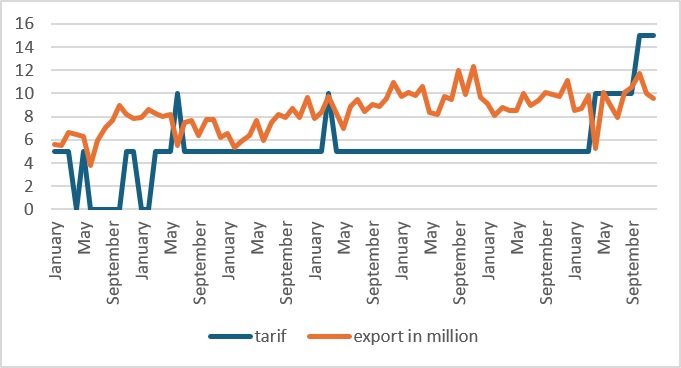
Export duties on raw materials are widely used to promote downstream industrialization, yet their effectiveness in supporting processed exports remains debated. This study evaluates the effectiveness of cocoa bean export duties, international cocoa prices, and domestic production in influencing cocoa powder export performance using an Error Correction Model (ECM). The analysis employs 83 time-series observations from Statistics Indonesia and the Ministry of Trade. The results show that export duty rates have a negative and significant effect on cocoa powder exports, while prices have positive and significant effects. The error correction term (–0.6352) is significant at the 1% level, suggesting that 63.5% of short-run deviations are corrected each period. The findings indicate that export duties may constrain processed cocoa exports when industrial capacity remains limited. The study provides empirical evidence on export duties and offers policy insights for designing downstream industrialization policies.
Marsanto Adi Nurcahyo, Politeknik Keuangan Negara STAN
 holds a Doctor of Economics degree from Universitas Trisakti, Indonesia in 2025. He received master’s degree from Universitas Narotama, Indonesia in 2011. He is currently a lecturer in Department of applied program in state finance management at Politeknik Keuangan Negara STAN. His research interests include in the fields of international trade, customs procedure, customs administration, and management. He can be contacted at email: marsanto.adi@pknstan.ac.id.
The Author Contribution is: Conceptualization, Validation, Formal Analysis, Investigation Resources, Data Curation, Writing – Original Draft, Writing – Review & Editing, Visualization, Supervision, Project Administration, Funding Acquisition
Masruri Muchtar, Politeknik Keuangan Negara STAN
 is currently an Associate Professor at Polytechnic of State Finance STAN, Indonesia. His educational background includes a Bachelor’s degree in Accounting from the Indonesian State College of Accountancy (STAN); a Bachelor’s degree in Economics from the Universitas Terbuka; a Master of Science in Management from the Universitas Gadjah Mada; a Master of E-Business Management from the International University of Japan; and a PhD in Islamic Economics from the Syarif Hidayatullah State Islamic University (UIN) Jakarta. He has published scientific works, including books and papers in reputable international and national journals. His research interests include economics, international trade, Islamic finance and banking. He can be contacted at email: masruri.m@pknstan.ac.id.
The Author Contribution is: Methodology, Software, Validation, Formal Analysis, Investigation Resources, Writing – Review & Editing
Downloads
[1] J. E. Kongor, M. Owusu, and C. Oduro-Yeboah, “Cocoa production in the 2020s: challenges and solutions,” CABI Agriculture and Bioscience, vol. 5, no. 1, p. 102, 2024, doi: 10.1186/s43170-024-00310-6.
[2] Ndikumana, Léonce, and Kwame Adjei-Mantey. Cocoa in Ghana, the ‘Political Crop’: Does state control shield the cocoa sector from exposure to capital flight. PERI Working Paper (forthcoming), 2023, doi: https://doi.org/10.1007/978-3-032-22770-6_4.
[3] Alaini, Soraya, Novi Rosanti, and Firdasari. "Export competitiveness of Indonesian cocoa derivative products in main destination countries," Jurnal Agrisep: Kajian Masalah Sosial Ekonomi Pertanian dan Agribisnis, 2025, pp. 341-360, doi: 10.31186/jagrisep.24.01.341-360.
[4] Aziziah, Sabila Aulia, and Nyoman Djinar Setiawina. "Analisis pengaruh produksi, harga dan nilai tukar terhadap ekspor biji kakao Indonesia ke Belanda." Cerdika: Jurnal Ilmiah Indonesia 1.4 (2021): 448-455, doi: https://doi.org/10.59141/cerdika.v1i4.67.
[5] R. K. Putri and T. M. Prihtanti, “Faktor-Faktor yang Mempengaruhi Volume Ekspor Kakao Indonesia Tahun 2007-2017,” Jurnal Ekonomi Pertanian dan Agribisnis, vol. 4, no. 3, pp. 528–536, 2020, doi: https://doi.org/10.21776/ub.jepa.2020.004.03.08.
[6] N. Adiyadnya and P. K. Sanjaya, “The Influence of Production Quantity, World Cocoa Prices, and Exchange Rates on Indonesian Cocoa Export Volume for the 2008-2023 Period,” JETISH: Journal of Education Technology Information Social Sciences and Health, vol. 3, pp. 1528–1548, Aug. 2024, doi: 10.57235/jetish.v3i2.3418.
[7] J. Neilson∗, “Global markets, farmers and the state: sustaining profits in the Indonesian cocoa sector,” Bull. Indones. Econ. Stud., vol. 43, no. 2, pp. 227–250, 2007, doi: https://doi.org/10.1080/00074910701408073.
[8] A. Deaton, “Commodity prices and growth in Africa,” Journal of economic Perspectives, vol. 13, no. 3, pp. 23–40, 1999, doi: https://doi.org/10.1257/jep.13.3.23.
[9] A. P. Kireyev, “Export Tax and Pricing Power: Two Hypotheses on the Cocoa Market in Côte d’Ivoire,” IMF Working Papers, vol. 2010, no. 269, p. A001, 2010, doi: 10.5089/9781455210763.001.A001.
[10] M. Martoyo, H. Alunaza, A. Ernianda, A. Putri, and M. A. L. Mosquera Montoya, “Implication of the Covid-19 Pandemic on the Governance of International Trade in the West Kalimantan’s Entikong Border,” Jurnal Manajemen Industri dan Logistik, vol. 6, no. 1, pp. 01–09, Jun. 2022, doi: 10.30988/jmil.v6i1.940.
[11] D. Ricardo, Principles of political economy and taxation, ed. by ECK Gonnner. 1891.
[12] E. O. Afoakwa, Chocolate science and technology. John Wiley & Sons, 2016.
[13] N. Arianto, K. Kasmad, L. Asmalah, and W. Gustia Wardani, “Digital Transformation in Logistics Companies and Its Impact on Human Resources Marketing Strategies and Competition in International Trade,” Jurnal Manajemen Industri dan Logistik, vol. 9, no. 2, pp. 167–179, Sep. 2025, doi: 10.30988/jmil.v9i2.1631.
[14] P. Krugman, M. Obstfeld, and M. J. Melitz, International Trade Theory & Policy, 11th ed. Harlow, UK: Pearson Education Limited, 2018.
[15] T. T. Hapsari and A. F. Yuniasih, “The determinant factors of Indonesian competitiveness of cocoa exports to Germany,” Jurnal Ekonomi Pembangunan, vol. 18, no. 1, pp. 75–84, 2020, doi: https://doi.org/10.29259/jep.v18i1.9978.
[16] R. Permani, “Optimal export tax rates of cocoa beans: A vector error correction model approach,” Australian Journal of Agricultural and Resource Economics, vol. 57, no. 4, pp. 579–600, Oct. 2013, doi: https://doi.org/10.1111/1467-8489.12011.
[17] K. Burger, “Optimal export taxes–the case of cocoa in Côte d’Ivoire,” 2008.
[18] W. M. Corden, Trade policy and economic welfare. Oxford University Press, 1997.
[19] A. Bouet, C. Estrades, and D. Laborde, “Differential export taxes along the oilseeds value chain: a partial equilibrium analysis,” 2012, doi: https://doi.org/10.2139/ssrn.2197456.
[20] S. I. Rheavanya, M. Taufiq, and A. F. Utami, “Analysis of the Impact of Export Duty Policy, Total Production of Cocoa Beans, and Imports of Cocoa Beans on Cocoa Butter Exports in Indonesia.,” International Journal of Economics (IJEC), vol. 3, no. 2, 2024, doi: https://doi.org/10.55299/ijec.v3i2.880.
[21] A. Fitri, R. Andriyanty, D. Agustia, M. P. Hutagaol, and H. Harianto, “The Impact of Indonesia’s Cocoa Downstream Policy on the Derivative Product Competitiveness, Export Specialization, and Farmers Benefits,” Habitat, vol. 36, no. 2, pp. 154–165, 2025, doi: https://doi.org/10.21776/ub.habitat.2025.036.2.13.
[22] R. A. Ramadhani, A. Rifin, and T. Novianti, “Analisis Daya Saing Dan Kebijakan Bea Keluar Pada Komoditas Kakao (Theobroma Cacao) Indonesia,” Analisis Kebijakan Pertanian, vol. 21, no. 2, pp. 171–186, 2023, doi: https://doi.org/10.21082/akp.v21i2.171-186.
[23] M. M. Olarte-Libreros, J. E. Rojas-Mora, H. F. Guerrero-Sierra, C. Niño, and N. De la Peña, “Effects of International Shocks on Cocoa Global Production,” Economies, vol. 13, no. 2, p. 48, 2025, doi: https://doi.org/10.3390/economies13020048.
[24] C. L. Gilbert, “Cocoa: Origin differentials and the living income differential,” Eur. J. Dev. Res., vol. 36, no. 4, pp. 777–802, 2024, doi: https://doi.org/10.1057/s41287-023-00612-x.
[25] R. Permani, “Optimal export tax rates of cocoa beans: A vector error correction model approach,” Australian Journal of Agricultural and Resource Economics, vol. 57, no. 4, pp. 579–600, 2013, doi: https://doi.org/10.1111/1467-8489.12011.
[26] M. A. Kireyev, Export tax and pricing power: two hypotheses on the cocoa market in Côte d’Ivoire. International Monetary Fund, 2010, doi: 10.5089/9781455210763.001.a001.
[27] H. Yudyanto and F. F. Hastiadi, “Analysis of the imposition of export tax on Indonesian cocoa beans: Impact on the processed cocoa export in Indonesia and Malaysia,” in Globalization, Productivity and Production Networks in ASEAN: Enhancing Regional Trade and Investment, Springer, 2019, pp. 169–189, doi: https://doi.org/10.1007/978-3-030-16510-9_7.
[28] A. Ridha, V. Silvia, A. Aliasuddin, and R. Masbar, “Asymmetric price transmission in the cocoa supply chain in Indonesia,” Economia agro-alimentare: XXIV, 1, 2022, pp. 1–21, 2022, doi: https://doi.org/10.3280/ecag2022oa12888.
[29] D. P. J. I. N. Nisa and E. Antriyandarti, “Determinants of Cocoa Bean Trade in the International Market: Gravity Model Approach.,” International Journal of Sustainable Development & Planning, vol. 18, no. 10, 2023, doi: https://doi.org/10.18280/ijsdp.181035.
[30] G. Nigatu, F. Badau, R. Seeley, and J. Hansen, “Factors contributing to changes in agricultural commodity prices and trade for the United States and the world,” 2020.
[31] Rifin, Amzul. "The Progressive Export Tax and Indonesia’ S Palm Oil Product Export Competitiveness." Buletin Ilmiah Litbang Perdagangan 13.2 (2019): 211-232, doi: https://doi.org/10.30908/bilp.v13i2.417.
[32] S. Hermawan and M. S. Amirullah, METODE PENELITIAN BISNIS Pendekatan Kuantitatif & Kualitatif. 2016.
[33] A. V. Intanna and H. Yusuf, “Faktor Pembentuk Harga Jual Produk CPO Asal Indonesia,” Jurnal Perspektif Bea dan Cukai, vol. 3, no. 2, 2019, doi: https://doi.org/10.31092/jpbc.v3i2.511.
[34] Sugiyono, Metode Penelitian Kuantitatif Kualitatif dan R&D. Bandung: Alfabeta, 2013.
[35] M. Nurcahyani, “Analisis penawaran ekspor Crude Palm Oil (CPO) indonesia ke china (pendekatan error correction model),” Agrifo: Jurnal Agribisnis Universitas Malikussaleh, vol. 5, no. 2, pp. 122–130, 2020, doi: https://doi.org/10.29103/ag.v5i2.3131.
[36] M. Nurcahyani, M. Masyhuri, and S. Hartono, “The Export Supply Of Indonesian Crude Palm Oil (CPO) To India,” Agro Ekonomi, vol. 29, no. 1, p. 18, Jul. 2018, doi: 10.22146/ae.29931.
[37] M. H. Ridho and M. A. Nurcahyo, “Pengaruh Harga, Nilai Tukar, Tarif Bea Keluar, Dana Perkebunan Sawit, dan Jumlah Produksi terhadap Nilai Ekspor Crude Palm Oil,” Tirtayasa Ekonomika, vol. 17, no. 2, pp. 225–248, Oct. 2022, doi: 10.35448/jte.v17i2.15240.
[38] H. Triyowati and J. N. Sabrina, “Faktor Penentu Ekspor Minyak Kelapa Sawit Di Indonesia,” Media Ekonomi, vol. 28, no. 1, pp. 79–90, Mar. 2021, doi: 10.25105/me.v28i1.7895.
[39] Bond, Marian E. "An econometric study of primary commodity exports from developing country regions to the world." Staff Papers 34.2 (1987): 191-227, doi: https://doi.org/10.5089/9781451946987.024.
[40] Murwendah and W. Desyani, “High Tax Burden Reduces Competitiveness: A Study of the Cocoa Industry in Indonesia,” Journal of Indonesian Economy and Business, vol. 38, no. 3, Sep. 2023, doi: 10.22146/jieb.v38i3.4408.
[41] R. Advent, ; Zulgani, and Nurhayani, “Analisis Faktor-Faktor yang Mempengaruhi Ekspor Minyak Kelapa Sawit di Indonesia Tahun 2000-2019,” Jurnal Perdagangan dan Industri Moneter, vol. 9, no. 1, pp. 2303–1204, 2021, doi: https://doi.org/10.22437/pim.v9i1.13652.
Copyright (c) 2026 Marsanto Adi Nurcahyo, Masruri Muchtar

This work is licensed under a Creative Commons Attribution 4.0 International License.
JMIL Jurnal Manajemen Industri dan Logistik (Journal of Industrial and Logistics Management) is an Open Access Journal. The authors who publish the manuscript in JMIL Jurnal Manajemen Industri dan Logistik agree to the following terms:

JMIL Jurnal Manajemen Industri dan Logistik is licensed under a Creative Commons Attribution 4.0 International License. This permits anyone to copy, redistribute, remix, transmit and adapt the work provided the original work and source is appropriately cited.
This means:
(1) Under the CC-BY license, authors retain ownership of the copyright for their article, but authors grant others permission to use the content of publications in JMIL Jurnal Manajemen Industri dan Logistik in whole or in part provided that the original work is properly cited. Users (redistributors) of JMIL Jurnal Manajemen Industri dan Logistik are required to cite the original source, including the author's names, JMIL Jurnal Manajemen Industri dan Logistik as the initial source of publication, year of publication, volume number, issue, and Digital Object Identifier (DOI); (2) Authors grant JMIL Jurnal Manajemen Industri dan Logistik the right of first publication. Although authors remain the copyright owner.