Supply Chain Sustainability as a Mediator of Sustainable Performance in Indonesian Logistics SMEs

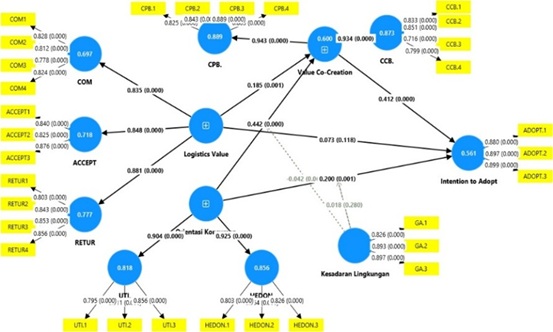
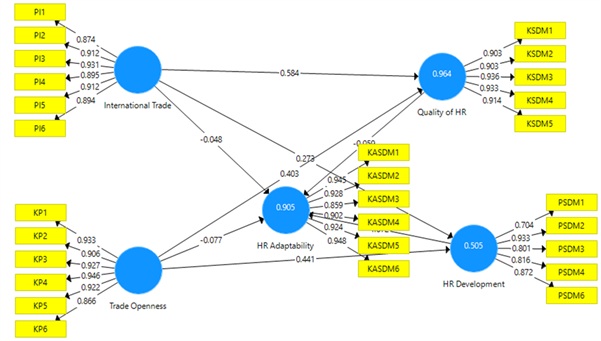
This study investigates supply chain sustainability as a mediating mechanism transforming organizational antecedents into sustainable performance outcomes among Indonesian logistics small and medium enterprises (SMEs). Drawing on stakeholder theory and resource-based view, we develop and test a mediation model using data from 284 Indonesian logistics SMEs across five geographic regions. Partial least squares structural equation modeling with 5,000 bootstrap resamples examines relationships between top management commitment, technology investment, human employee engagement, supply chain sustainability, and sustainable performance. Results reveal complete mediation patterns where supply chain sustainability fully mediates relationships between organizational antecedents and sustainable performance.
Downloads
Adda, G., Azigwe, J. B., & Awuni, A. R. (2021). Business sustainability practices and competitive advantage of small and medium enterprises in Ghana. Journal of Small Business and Enterprise Development, 28(2), 157-175. https://doi.org/10.1108/JSBED-03-2020-0100
Ahmad, M., Majeed, A., Khan, M. A., Sohaib, M., & Shehzad, K. (2022). Digital transformation for sustainable development: A systematic literature review. Journal of Cleaner Production, 358, 131982. https://doi.org/10.1016/j.jclepro.2022.131982
Amankwah-Amoah, J., Khan, Z., Wood, G., & Knight, G. (2021). COVID-19 and digitalization: The great acceleration. Journal of Business Research, 136, 602-611. https://doi.org/10.1016/j.jbusres.2021.08.011
Amini, M., & Bienstock, C. C. (2014). Corporate sustainability: An integrative definition and framework to evaluate corporate practice and guide academic research. Journal of Cleaner Production, 76, 12-19. https://doi.org/10.1016/j.jclepro.2014.02.016
Armstrong, J. S., & Overton, T. S. (1977). Estimating nonresponse bias in mail surveys. Journal of Marketing Research, 14(3), 396-402. https://doi.org/10.1177/002224377701400320
Bag, S., Yadav, G., Dhamija, P., & Kataria, K. K. (2021). Key resources for industry 4.0 adoption and its effect on sustainable production and circular economy: An empirical study. Journal of Cleaner Production, 281, 125233. https://doi.org/10.1016/j.jclepro.2020.125233
Barney, J. (1991). Firm resources and sustained competitive advantage. Journal of Management, 17(1), 99-120. https://doi.org/10.1177/014920639101700108
Baron, R. M., & Kenny, D. A. (1986). The moderator--mediator variable distinction in social psychological research: Conceptual, strategic, and statistical considerations. Journal of Personality and Social Psychology, 51(6), 1173-1182. https://doi.org/10.1037/0022-3514.51.6.1173
Carter, C. R., & Rogers, D. S. (2008). A framework of sustainable supply chain management: Moving toward new theory. International Journal of Physical Distribution & Logistics Management, 38(5), 360-387. https://doi.org/10.1108/09600030810882816
Cohen, J. (1988). Statistical Power Analysis for the Behavioral Sciences (2nd ed.). Lawrence Erlbaum Associates.
Daily, B. F., & Huang, S. C. (2001). Achieving sustainability through attention to human resource factors in environmental management. International Journal of Operations & Production Management, 21(12), 1539-1552. https://doi.org/10.1108/01443570110410892
DiMaggio, P. J., & Powell, W. W. (1983). The iron cage revisited: Institutional isomorphism and collective rationality in organizational fields. American Sociological Review, 48(2), 147-160. https://doi.org/10.2307/2095101
Dubey, R., Gunasekaran, A., Childe, S. J., Papadopoulos, T., Luo, Z., Wamba, S. F., & Roubaud, D. (2017). Can big data and predictive analytics improve social and environmental sustainability? Technological Forecasting and Social Change, 144, 534-545. https://doi.org/10.1016/j.techfore.2017.06.020
El-Kassar, A. N., & Singh, S. K. (2019). Green innovation and organizational performance: The influence of big data and the moderating role of management commitment and HR practices. Technological Forecasting and Social Change, 144, 483-498. https://doi.org/10.1016/j.techfore.2017.12.016
Elkington, J. (1997). Cannibals with Forks: The Triple Bottom Line of 21st Century Business. Capstone Publishing.
Fahimnia, B., Sarkis, J., & Davarzani, H. (2015). Green supply chain management: A review and bibliometric analysis. International Journal of Production Economics, 162, 101-114. https://doi.org/10.1016/j.ijpe.2015.01.003
Feng, M., Yu, W., Wang, X., Wong, C. Y., Xu, M., & Xiao, Z. (2018). Green supply chain management and financial performance: The mediating roles of operational and environmental performance. Business Strategy and the Environment, 27(7), 811-824. https://doi.org/10.1002/bse.2033
Fornell, C., & Larcker, D. F. (1981). Evaluating structural equation models with unobservable variables and measurement error. Journal of Marketing Research, 18(1), 39-50. https://doi.org/10.1177/002224378101800104
Freeman, R. E. (1984). Strategic Management: A Stakeholder Approach. Pitman.
Golicic, S. L., & Smith, C. D. (2013). A meta‐analysis of environmentally sustainable supply chain management practices and firm performance. Journal of Supply Chain Management, 49(2), 78-95. https://doi.org/10.1111/jscm.12006
Hair, J. F., Risher, J. J., Sarstedt, M., & Ringle, C. M. (2019). When to use and how to report the results of PLS-SEM. European Business Review, 31(2), 2-24. https://doi.org/10.1108/EBR-11-2018-0203
Hart, S. L. (1995). A natural-resource-based view of the firm. Academy of Management Review, 20(4), 986-1014. https://doi.org/10.5465/amr.1995.9512280033
Hart, S. L., & Dowell, G. (2011). Invited editorial: A natural-resource-based view of the firm: Fifteen years after. Journal of Management, 37(5), 1464-1479. https://doi.org/10.1177/0149206310390219
Hayes, A. F. (2017). Introduction to Mediation, Moderation, and Conditional Process Analysis: A Regression-Based Approach (2nd ed.). Guilford Publications.
Henseler, J., Ringle, C. M., & Sarstedt, M. (2015). A new criterion for assessing discriminant validity in variance-based structural equation modeling. Journal of the Academy of Marketing Science, 43(1), 115-135. https://doi.org/10.1007/s11747-014-0403-8
Hubbard, G. (2009). Measuring organizational performance: Beyond the triple bottom line. Business Strategy and the Environment, 18(3), 177-191. https://doi.org/10.1002/bse.564
Jabbour, C. J. C., Fiorini, P. D. C., Ndubisi, N. O., Queiroz, M. M., & Piato, É. L. (2020). Digitally-enabled sustainable supply chains in the 21st century: A review and a research agenda. Science of the Total Environment, 725, 138177. https://doi.org/10.1016/j.scitotenv.2020.138177
Jabbour, C. J. C., Mauricio, A. L., & Jabbour, A. B. L. (2019). Critical success factors and green supply chain management proactivity: Shedding light on the human aspects of this relationship based on cases from the Brazilian automotive industry. Production Planning & Control, 28(8), 671-683. https://doi.org/10.1080/09537287.2017.1309705
Jones, T. M., Harrison, J. S., & Felps, W. (2018). How applying instrumental stakeholder theory can provide sustainable competitive advantage. Academy of Management Review, 43(3), 371-391. https://doi.org/10.5465/amr.2016.0111
Kumar, A., Mangla, S. K., Luthra, S., & Ishizaka, A. (2021). Evaluating the human resource related soft dimensions to sustainable supply chain management in small and medium enterprises. Production Planning & Control, 32(16), 1398-1416. https://doi.org/10.1080/09537287.2020.1797142
MacKenzie, S. B., & Podsakoff, P. M. (2012). Common method bias in marketing: Causes, mechanisms, and procedural remedies. Journal of Retailing, 88(4), 542-555. https://doi.org/10.1016/j.jretai.2012.08.001
Ministry of Environment and Forestry. (2023). Indonesia's long-term strategy for low carbon and climate resilience 2050. Government of Indonesia.
Ministry of Transportation. (2023). Transportation statistics 2023. Government of Indonesia.
Montabon, F., Pagell, M., & Wu, Z. (2016). Making sustainability sustainable. Journal of Supply Chain Management, 52(2), 11-27. https://doi.org/10.1111/jscm.12103
Norton, T. A., Parker, S. L., Zacher, H., & Ashkanasy, N. M. (2015). Employee green behavior: A theoretical framework, multilevel review, and future research agenda. Organization & Environment, 28(1), 103-125. https://doi.org/10.1177/1086026615575773
Norton, T. A., Zacher, H., & Ashkanasy, N. M. (2017). Organisational sustainability policies and employee green behaviour: The mediating role of work climate perceptions. Journal of Environmental Psychology, 38, 49-54. https://doi.org/10.1016/j.jenvp.2014.01.002
OECD. (2018). SME and Entrepreneurship Policy in Indonesia 2018. OECD Studies on SMEs and Entrepreneurship, OECD Publishing. https://doi.org/10.1787/9789264306264-en
Ones, D. S., & Dilchert, S. (2012). Environmental sustainability at work: A call to action. Industrial and Organizational Psychology, 5(4), 444-466. https://doi.org/10.1111/j.1754-9434.2012.01478.x
Podsakoff, P. M., MacKenzie, S. B., & Podsakoff, N. P. (2012). Sources of method bias in social science research and recommendations on how to control it. Annual Review of Psychology, 63, 539-569. https://doi.org/10.1146/annurev-psych-120710-100452
Porter, M. E., & Kramer, M. R. (2011). Creating shared value. Harvard Business Review, 89(1/2), 62-77.
Preacher, K. J., & Hayes, A. F. (2008). Asymptotic and resampling strategies for assessing and comparing indirect effects in multiple mediator models. Behavior Research Methods, 40(3), 879-891. https://doi.org/10.3758/BRM.40.3.879
Putri, A. R., & Indrawati, N. K. (2021). Sustainability practices implementation in Indonesian SMEs: A systematic literature review. Journal of Cleaner Production, 284, 124729. https://doi.org/10.1016/j.jclepro.2020.124729
Rahman, M. S., Abdel Fattah, F. A. M., Bag, S., & Gani, M. O. (2021). Survival strategies of SMEs amidst the COVID-19 pandemic: Application of SEM-ANN approach. Benchmarking: An International Journal, 29(1), 391-419. https://doi.org/10.1108/BIJ-09-2020-0481
Rahayu, R., & Day, J. (2017). E-commerce adoption by SMEs in developing countries: Evidence from Indonesia. Eurasian Business Review, 7(1), 25-41. https://doi.org/10.1007/s40821-016-0044-6
Russo, M. V., & Fouts, P. A. (1997). A resource-based perspective on corporate environmental performance and profitability. Academy of Management Journal, 40(3), 534-559. https://doi.org/10.5465/257052
Scott, W. R. (2008). Institutions and Organizations: Ideas and Interests (3rd ed.). Sage Publications.
Seles, B. M. R. P., de Sousa Jabbour, A. B. L., Jabbour, C. J. C., & Dangelico, R. M. (2016). The green bullwhip effect, the diffusion of green supply chain practices, and institutional pressures: Evidence from the automotive sector. International Journal of Production Economics, 182, 342-355. https://doi.org/10.1016/j.ijpe.2016.08.033
Seuring, S., & Müller, M. (2008). From a literature review to a conceptual framework for sustainable supply chain management. Journal of Cleaner Production, 16(15), 1699-1710. https://doi.org/10.1016/j.jclepro.2008.04.020
Silvestre, B. S. (2015). Sustainable supply chain management in emerging economies: Environmental turbulence, institutional voids and sustainability trajectories. International Journal of Production Economics, 167, 156-169. https://doi.org/10.1016/j.ijpe.2015.05.025
Singh, S., & Trivedi, A. (2020). Sustainable green supply chain management: Trends and current practices. Competitiveness Review, 26(2), 265-288. https://doi.org/10.1108/CR-05-2015-0036
Susanto, H., Gunawan, F. E., Riyadi, S., Rahman, A., Santoso, H. B., & Suharjito. (2022). Toward sustainable competitive advantage: Green supply chain management practices, green human resource management and green customer relationship management. Sustainability, 14(11), 6839. https://doi.org/10.3390/su14116839
Thorisdottir, T. S., & Johannsdottir, L. (2020). Sustainability within fashion business models: A systematic literature review. Sustainability, 12(21), 8931. https://doi.org/10.3390/su12218931
Touboulic, A., & Walker, H. (2015). Theories in sustainable supply chain management: A structured literature review. International Journal of Physical Distribution & Logistics Management, 45(1/2), 16-42. https://doi.org/10.1108/IJPDLM-05-2013-0106
UNIDO. (2020). Industrial development report 2020: Industrializing in the digital age. United Nations Industrial Development Organization.
Wamba, S. F., Queiroz, M. M., & Trinchera, L. (2017). Dynamics between blockchain adoption determinants and supply chain performance: An empirical investigation. International Journal of Production Economics, 229, 107817. https://doi.org/10.1016/j.ijpe.2020.107817
Wasiq, M., Kamal, M., & Ali, S. (2023). Factors influencing green supply chain management implementation in manufacturing firms. Journal of Manufacturing Technology Management, 34(2), 285-307. https://doi.org/10.1108/JMTM-08-2022-0294
Yusoff, Y. M., Omar, M. K., Zaman, M. D. K., & Samad, S. (2019). Do all elements of green intellectual capital contribute toward business sustainability? Evidence from the Malaysian context. Sustainability, 11(23), 6684. https://doi.org/10.3390/su11236684
Yusoff, Y. M., Othman, N. Z., Fernando, Y., Amran, A., Surienty, L., & Ramayah, T. (2020). Conceptualizing green human resource management and corporate environmental behavior relationship: The role of green culture. International Journal of Manpower, 41(7), 1011-1027. https://doi.org/10.1108/IJM-05-2019-0249
Copyright (c) 2025 Ferdy, Stefanus Kaihatu, Timotius Febry Christian

This work is licensed under a Creative Commons Attribution 4.0 International License.
JMIL Jurnal Manajemen Industri dan Logistik (Journal of Industrial and Logistics Management) is an Open Access Journal. The authors who publish the manuscript in JMIL Jurnal Manajemen Industri dan Logistik agree to the following terms:

JMIL Jurnal Manajemen Industri dan Logistik is licensed under a Creative Commons Attribution 4.0 International License. This permits anyone to copy, redistribute, remix, transmit and adapt the work provided the original work and source is appropriately cited.
This means:
(1) Under the CC-BY license, authors retain ownership of the copyright for their article, but authors grant others permission to use the content of publications in JMIL Jurnal Manajemen Industri dan Logistik in whole or in part provided that the original work is properly cited. Users (redistributors) of JMIL Jurnal Manajemen Industri dan Logistik are required to cite the original source, including the author's names, JMIL Jurnal Manajemen Industri dan Logistik as the initial source of publication, year of publication, volume number, issue, and Digital Object Identifier (DOI); (2) Authors grant JMIL Jurnal Manajemen Industri dan Logistik the right of first publication. Although authors remain the copyright owner.