Improving Storage Capacity and Space Utilization through COI Dedicated Storage and Rack Based Layout Redesign of a Bottled Drinking Water Warehouse

Downloads
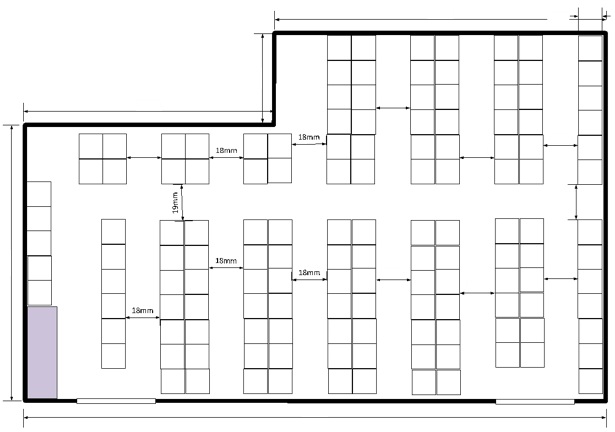
The main problem in the Danone bottled drinking water (DBDW) warehouse is the narrow aisles resulting from efforts to maximize warehouse space capacity. Other problems include excessive pallet stacking height, the use of non-standard pallets, and the random storage policy applied in the warehouse. The purpose of this case study is to redesign the layout of the DBDW facility by first analyzing the layout of goods storage in the warehouse. Reassigning products with the Cube per Order Index (COI)-dedicated storage policy reduced the total travel distance by only about 4%, so the warehouse layout was redesigned and two storage media, a rack system and a block-stacking system, were compared. The results of the comparison show that the layout with rack storage media is more feasible to use than block stacking storage media in terms of warehouse utility and the number of goods stored. The new warehouse can store 1156 more items and secure pallet stacking.
Edo Rantou Wijaya, Agro-Industry Logistics Management, Politeknik ATI Padang, Bungo Pasang Tabing, Padang, 25171
 holds a master’s degree in Industrial Engineering and Management from Institut Teknologi Bandung, Indonesia. He is currently an assistant professor and the head of Agro-Industry Logistics Management Department at Politeknik ATI Padang, Indonesia. His research focuses on warehouse management, logistics decision making, and facilities design. He has published research articles in reputable journals and proceedings, including Jurnal Rekayasa Sistem Industri, Manajemen IKM, and IOP Conference Series: Materials Science and Engineering.
The Author Contribution (Corresponding Author): Conceptualization, Methodology, Formal Analysis, Investigation, Writing-Original Draft, Writing-Review & Editing, Supervision
Indah Kurnia Ramadhani, Agro-Industry Logistics Management, Politeknik ATI Padang, Bungo Pasang Tabing, Padang, 25171,
 completed her master’s degree in Industrial Engineering and Management at Institut Teknologi Bandung, Indonesia in 2021. She started her career as a lecturer at Politeknik ATI Padang in 2022. Indah is currently a secretary at Agro-Industry Logistics Management Department. Her research interests are in the area of scheduling, maintenance, and inventory. She actively disseminates her research at various conferences and has been awarded as a best speaker at the International Conference of Industrial Engineering and Innovation (ICIEI) 2025 and the National Seminar of Industrial Engineering (SENASTI) 2023. She has published papers in national accredited journals in Indonesia, for instance, Jurnal Optimasi Sistem Industri and Jurnal IPTEK.
The Author Contribution (Author): Methodology, Writing-Original Draft, Funding Acquisition
Yuda Hadinata, Agro-Industry Logistics Management, Politeknik ATI Padang, Bungo Pasang Tabing, Padang, 25171,
 holds a Diploma degree in Agro-Industry Logistics Management from Politeknik ATI Padang, Indonesia. He is currently a Research Assistant at the Agro-Industry Logistics Management Department, Politeknik ATI Padang. His research focuses on Warehouse Management. He actively disseminates her research at conferences.
The Author Contribution (Author): Investigation, Data Curation, Visualization, Resources, and Project Administration
Downloads
[1] Y. Muharni, Kulsum, and M. Khoirunnisa, “Warehouse Layout Designing of Slab Using Dedicated Storage and Particle Swarm Optimization,” IOP Conf. Ser. Mater. Sci. Eng., vol. 532, no. 1, 2019, doi: 10.1088/1757-899X/532/1/012003.
[2] M. Ang and Y. F. Lim, “How to optimize storage classes in a unit-load warehouse,” Eur. J. Oper. Res., vol. 278, no. 1, pp. 186–201, 2019, doi: 10.1016/j.ejor.2019.03.046.
[3] S. Gunnervald and V. Gustafsson, “Development of a layout for effective use of space in a block stacking warehouse,” Linkoping University, 2017. [Online]. Available: https://www.diva-portal.org/smash/get/diva2:1117142/FULLTEXT01.pdf
[4] S. S. Heragu, Facilities Design, 4th ed. New York: CRC Press; Taylor & Francis Group, 2016. doi: 10.1016/B978-0-12-387000-1.01001-9.
[5] J. Gu, M. Goetschalckx, and L. F. McGinnis, “Research on warehouse design and performance evaluation: A comprehensive review,” Eur. J. Oper. Res., vol. 203, no. 3, pp. 539–549, 2010, doi: 10.1016/j.ejor.2009.07.031.
[6] S. Derhami, “Designing Optimal Layouts for Block Stacking Warehouses,” Auburn University, 2017.
[7] B. Y. Ekren, Z. Sari, and T. Lerher, “Warehouse design under class-based storage policy of shuttle-based storage and retrieval system,” IFAC-PapersOnLine, vol. 28, no. 3, pp. 1152–1154, 2015, doi: 10.1016/j.ifacol.2015.06.239.
[8] T. P. Sari, A. Y. Ridwan, and R. Aurachman, “Designing Floor Tile Warehouse Layout Using Heuristic Approach Method to Increase Warehouse Capacity and Reduce Travel Distance,” International Journal of Innovation in Enterprise System, vol. 1, no. 01, pp. 44–52, 2017, doi: 10.25124/ijies.v1i01.8.
[9] R. Nofal, A. Y. Ridwan, and B. Santosa, “Design of Chemical Products Warehouse Layout Using Heuristic Approach and Share Storage Method to Improve Capacity and Reduce Out Of Block Products,” Proceeding of the 11th International Conference of Logistics and Supply Chain Systems (ICLS) 2016, vol. 11, no. 1, pp. 455–461, 2016, [Online]. Available: https://ariyanuar.staff.telkomuniversity.ac.id/files/2017/11/ICLS2016_RNoval_AYRidwan_BSantosa-1.pdf
[10] S. Derhami, J. S. Smith, and K. R. Gue, “A simulation-based optimization approach to design optimal layouts for block stacking warehouses,” Int. J. Prod. Econ., vol. 223, 2020, doi: 10.1016/j.ijpe.2019.107525.
[11] D. Wicaksono, I. Setiawan, and F. L. Hasan, “Layout Redesign to Eliminate Stagnation Using Blocplan to Increase Production Efficiency,” Opsi, vol. 15, no. 2, p. 238, 2022, doi: 10.31315/opsi.v15i2.8023.
[12] T. K. Park and K. H. Kim, “Comparing handling and space costs for various types of stacking methods,” Comput. Ind. Eng., vol. 58, no. 3, pp. 501–508, 2010, doi: 10.1016/j.cie.2009.11.011.
[13] R. Venkitasubramony and G. K. Adil, “Modeling the effect of imperfect staggering in product inflow using queuing theory: revisiting block stacking layout,” Flex. Serv. Manuf. J., vol. 33, no. 3, pp. 689–716, 2021, doi: 10.1007/s10696-020-09390-8.
[14] R. Venkitasubramony and G. K. Adil, “An integrated design approach for class-based block stacked warehouse,” Facilities, vol. 37, no. 13–14, pp. 919–941, 2019, doi: 10.1108/F-04-2018-0056.
[15] J. H. Yang and K. H. Kim, “A grouped storage method for minimizing relocations in block stacking systems,” J. Intell. Manuf., vol. 17, no. 4, pp. 453–463, 2006, doi: 10.1007/s10845-005-0018-5.
[16] D. W. Jang, S. W. Kim, and K. H. Kim, “The optimization of mixed block stacking requiring relocations,” Int. J. Prod. Econ., vol. 143, no. 2, pp. 256–262, 2013, doi: 10.1016/j.ijpe.2012.06.033.
[17] G. Baruffaldi, R. Accorsi, D. Santi, R. Manzini, and F. Pilati, The storage of perishable products: A decision-support tool to manage temperature-sensitive products warehouses. Elsevier Inc., 2019. doi: 10.1016/B978-0-12-813411-5.00009-0.
[18] J. C. H. Pan and M. H. Wu, “A study of storage assignment problem for an order picking line in a pick-and-pass warehousing system,” Comput. Ind. Eng., vol. 57, no. 1, pp. 261–268, 2009, doi: 10.1016/j.cie.2008.11.026.
[19] J. C. H. Pan, M. H. Wu, and W. L. Chang, “A travel time estimation model for a high-level picker-to-part system with class-based storage policies,” Eur. J. Oper. Res., vol. 237, no. 3, pp. 1054–1066, 2014, doi: 10.1016/j.ejor.2014.02.037.
[20] A. S. Dijkstra and K. J. Roodbergen, “Exact route-length formulas and a storage location assignment heuristic for picker-to-parts warehouses,” Transp. Res. E Logist. Transp. Rev., vol. 102, pp. 38–59, 2017, doi: 10.1016/j.tre.2017.04.003.
[21] R. M. Elbert, T. Franzke, C. H. Glock, and E. H. Grosse, “The effects of human behavior on the efficiency of routing policies in order picking: The case of route deviations,” Comput. Ind. Eng., vol. 111, pp. 537–551, 2017, doi: 10.1016/j.cie.2016.11.033.
[22] T. van Gils, K. Ramaekers, K. Braekers, B. Depaire, and A. Caris, “Increasing order picking efficiency by integrating storage, batching, zone picking, and routing policy decisions,” Int. J. Prod. Econ., vol. 197, pp. 243–261, 2018, doi: 10.1016/j.ijpe.2017.11.021.
[23] F. T. S. Chan and H. K. Chan, “Improving the productivity of order picking of a manual-pick and multi-level rack distribution warehouse through the implementation of class-based storage,” Expert Syst. Appl., vol. 38, no. 3, pp. 2686–2700, 2011, doi: 10.1016/j.eswa.2010.08.058.
[24] C. Theys, O. Bräysy, W. Dullaert, and B. Raa, “Using a TSP heuristic for routing order pickers in warehouses,” Eur. J. Oper. Res., vol. 200, no. 3, pp. 755–763, 2010, doi: 10.1016/j.ejor.2009.01.036.
[25] P. W. Albert, M. Rönnqvist, and N. Lehoux, “Trends and new practical applications for warehouse allocation and layout design: a literature review,” SN Appl. Sci., vol. 5, no. 12, 2023, doi: 10.1007/s42452-023-05608-0.
[26] H. Aziz, M. Choiri, and A. Rahman, “Perancangan Tata Letak Dan Pallet Racking System Sebagai Pendukung Pengendalian Barang Di Gudang Produk Jadi,” Jurnal. Jurusan Teknik Industri Fakultas Teknik Universitas Brawijaya, pp. 348–359, 2013, [Online]. Available: https://scholar.google.com/citations?view_op=view_citation&hl=en&user=7QS_NpoAAAAJ&cstart=20&pagesize=80&citation_for_view=7QS_NpoAAAAJ:j3f4tGmQtD8C
[27] E. Wijaya, “Layout Analysis of Goods Storage: Case Study Spare Part Warehouse Z Company,” Jurnal Rekayasa Sistem Industri, vol. 11, no. 1, pp. 47–56, Apr. 2022, doi: 10.26593/jrsi.v11i1.5139.47-56.
[28] W. Kartika and A. W. Helvianto, “PERBAIKAN TATA LETAK PENYIMPANAN BARANG DI GUDANG UNTUK REDUKSI JARAK TEMPUH PERJALANAN MATERIAL HANDLING WINANDA,” Jurnal Manajemen Industri Dan Logistik, vol. 1, no. 1, pp. 56–70, 2018, doi: 10.30988/jmil.v1i1.6.
[29] M. ten Hompel and T. Schmidt, Warehouse Management. New York: Springer-Verlag Berlin Heidelberg, 2007. doi: 10.1007/978-3-540-35220-4_1.
[30] R. Gwynne, WAREHOUSE MANAGEMENT, 2nd ed. London Philadelphia New Delhi: Kogan Page, 2014.
Copyright (c) 2026 Edo Rantou Wijaya, Indah Kurnia Ramadhani, Yuda Hadinata

This work is licensed under a Creative Commons Attribution 4.0 International License.
JMIL Jurnal Manajemen Industri dan Logistik (Journal of Industrial and Logistics Management) is an Open Access Journal. The authors who publish the manuscript in JMIL Jurnal Manajemen Industri dan Logistik agree to the following terms:

JMIL Jurnal Manajemen Industri dan Logistik is licensed under a Creative Commons Attribution 4.0 International License. This permits anyone to copy, redistribute, remix, transmit and adapt the work provided the original work and source is appropriately cited.
This means:
(1) Under the CC-BY license, authors retain ownership of the copyright for their article, but authors grant others permission to use the content of publications in JMIL Jurnal Manajemen Industri dan Logistik in whole or in part provided that the original work is properly cited. Users (redistributors) of JMIL Jurnal Manajemen Industri dan Logistik are required to cite the original source, including the author's names, JMIL Jurnal Manajemen Industri dan Logistik as the initial source of publication, year of publication, volume number, issue, and Digital Object Identifier (DOI); (2) Authors grant JMIL Jurnal Manajemen Industri dan Logistik the right of first publication. Although authors remain the copyright owner.